
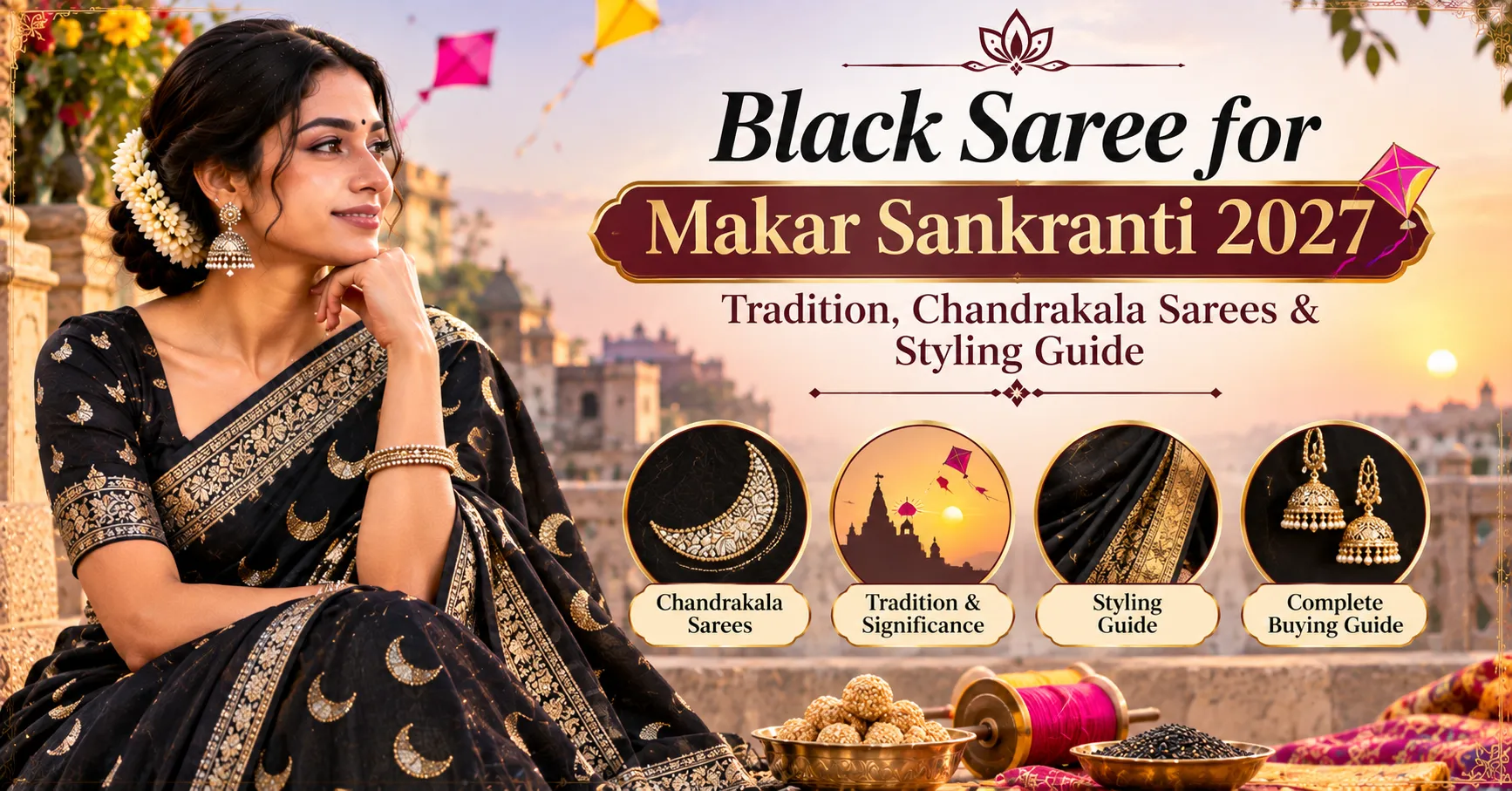
Black Saree for Makar Sankranti 2027: Tradition, Chandrakala Sarees & Styling Guide
On most Indian festival days, black stays in the cupboard. Makar Sankranti is the famous exception. Across Maharashtra, women step out in black sarees for haldi-kunku gatherings, new brides wear black with glittering white halwa jewellery, and every greeting comes with a handful of tilgul and the words “tilgul ghya, god god bola” — take this sweet and speak sweetly.
This guide explains why black is worn on Sankranti, the story of the Chandrakala saree, what new brides wear for their first Sankranti, and the best black handloom sarees for 2027 — plus how the rest of India dresses for the harvest festival.
| Sankranti 2027 at a Glance
• Bhogi and Lohri: Thursday, 14 January 2027 • Makar Sankranti: Friday, 15 January 2027. The sun enters Makara (Capricorn) at about 9:14 PM IST on 14 January — after sunset — so the festival and its punya kaal are observed the next morning. • Thai Pongal and Uttarayan: Friday, 15 January • Mattu Pongal, Kanuma and Vasi Uttarayan: Saturday, 16 January • Haldi-kunku and bornahan: in many homes, from Sankranti until Ratha Saptami • Celebrating abroad? In North America and the UK, Sankranti falls on Thursday, 14 January local time. |
Why Do Women Wear Black on Makar Sankranti?
Black is usually avoided on auspicious days, which is why the Sankranti custom surprises people. There is no single official reason, but these are the explanations most families give:
- It’s the heart of winter. Sankranti falls in the coldest weeks of the year, and black absorbs and holds heat — a practical choice for early-morning rituals and outdoor celebrations.
- On this day, black means warmth and protection. As the sun moves into Makara, many see black as a symbol of strength and protection rather than something to avoid.
- It’s simply tradition. For generations of Maharashtrian women, the black Sankranti saree has been as much a part of the festival as tilgul and kite-flying.
The custom is strongest in Maharashtra and among Marathi families elsewhere in India and abroad. In most other regions, people wear bright new clothes for the harvest festival instead (see the regional table below). Customs vary between families, so if you’re celebrating with your in-laws for the first time, it’s worth asking.
The Chandrakala Saree: Sankranti’s Night-Sky Saree
The Chandrakala — named after the phases of the moon — is the saree most closely tied to Sankranti. It was woven in jet-black or deep-blue silk to look like the night sky, with small gold moon and star motifs scattered across it. Marathi songs, books and paintings mention it, and it was traditionally gifted to a bride for her first Sankranti.
Weavers had largely stopped making it by the mid-20th century, though its spirit lived on in black Paithanis. In 2017, textile revivalist Vinay Narkar brought the Chandrakala back with handloom weavers, and the name now appears in many Sankranti collections.
Can’t find a true Chandrakala? A black handloom saree with small gold or silver buttis gives the same night-sky effect — our guide to zari explains how gold and silver zari differ. Buying a first-Sankranti saree for a daughter or daughter-in-law? See our saree gift guide.
Best Black Handloom Sarees for Sankranti
- Black Paithani: the classic Maharashtrian choice — a black body with a bright zari border and a peacock or lotus pallu. Choose silk for a bride’s first Sankranti and cotton Paithani for daytime haldi-kunku. For inspiration, see our Paithani wedding guide and top 10 handloom Paithanis, or browse the Paithani collection.
- Black with a contrast border: black with a red, yellow, green, pink or gold border is the look most Maharashtrian women picture for Sankranti. A black Maheshwari with a red or silver zari border does this beautifully — see our Maheshwari colour guide.
- Black pure silk Chanderi: light, with a soft sheen — ideal if you’ll be visiting several haldi-kunku gatherings. Try our Midnight Black Chanderi with gold zari or the black Chanderi with a silver zari border — the silver is the closest to the Chandrakala’s moonlit look. For a lighter budget, there’s a black cotton-silk Chanderi. Our Chanderi buying guide explains the difference.
- Black-and-gold Banarasi: for a richer first-Sankranti look, a black Banarasi with gold buttis echoes the Chandrakala’s star-studded sky. Our Shobhana black and gold Khaddi Georgette Banarasi drapes softly and is easy to wear all day.
- Black Jamdani: fine handwoven cotton with woven motifs, comfortable for daytime gatherings. Our black cotton Jamdani with red and golden motifs is an affordable pick. Read our Jamdani buyer’s guide first.
- Black-and-red Ikat: bold geometric patterns that feel festive and modern. Learn how to spot authentic Ikat and browse our Ikat collection.
Black Sankranti sarees by budget
| Budget | Black Handloom Picks | Best For |
| Under ₹5,000 | Cotton-silk Chanderi, cotton Jamdani, Mangalagiri cotton | Haldi-kunku visits, office, daytime |
| ₹5,000–₹15,000 | Cotton Paithani, Maheshwari silk, Pochampally Ikat, Khaddi georgette Banarasi | Sankranti day, family celebrations |
| Above ₹15,000 | Pure silk Chanderi with zari, silk Paithani, finely woven Jamdani | A bride’s first Sankranti; an heirloom gift |
Prices depend on fabric, zari and weaving time — see our handloom saree price guide for realistic benchmarks.
First Sankranti for New Brides
A bride’s first Sankranti after marriage (the pahili sankrant) is a big occasion in Maharashtrian families. Many in-laws host a haldi-kunku in her honour, and she dresses in a black saree — often a gift from the family — with halwa jewellery.
What is halwa jewellery?
Halwa dagine are ornaments made from halwa — tiny sugar-coated beads traditionally made with sesame — threaded on cotton and decorated. A bride’s set can include a mangalsutra, necklace, earrings, maang tikka, nath, kamarpatta and anklets. The groom usually wears a halwa garland, ring or bracelet, often with a black kurta, and babies celebrating their first Sankranti wear halwa ornaments too. The white beads look stunning against black.
Tip: halwa jewellery is delicate and sold mainly in December and January, so order early and keep it away from moisture.
Haldi-kunku and bornahan
In the weeks after Sankranti — in many homes until Ratha Saptami — married women invite each other for haldi-kunku: applying haldi and kunku, sharing tilgul and exchanging small gifts. For children up to about five, families hold a bornahan, showering the child with puffed rice, sugar candies, sesame sweets and pieces of sugarcane for good health.
A comfortable black cotton or Chanderi saree works well for these afternoon gatherings; our guide to sarees for temple visits and pooja has more tips for ritual days. For Maharashtrian bridal style — Paithanis and the nauvari drape — see our guide to bridal sarees across India.
How the Rest of India Dresses for the Harvest Festival
Makar Sankranti goes by many names. Black is mainly a Maharashtrian custom; elsewhere, the harvest festival is a time for bright new clothes.
| Region | Festival (2027) | What Many Women Wear | Handloom Pick |
| Maharashtra | Makar Sankranti, 15 Jan; haldi-kunku after | Black sarees, often with bright or zari borders; halwa jewellery for new brides | Black Paithani or Chanderi |
| Tamil Nadu | Pongal, 14–17 Jan | New sarees in bright silk or crisp cotton | South Indian cotton, Mangalagiri |
| Andhra Pradesh & Telangana | Bhogi, Sankranti, Kanuma, 14–16 Jan | New silk sarees; many girls wear a langa voni (half-saree) | Pochampally Ikat, Mangalagiri |
| Karnataka | Sankranti, 15 Jan | New sarees; ellu-bella (sesame-jaggery mix) shared with neighbours | Chanderi or Mangalagiri cotton silk |
| Gujarat | Uttarayan, 15–16 Jan | Bright, easy outfits for rooftop kite-flying; Bandhani is a favourite | Ajrakh or Ikat |
| Punjab | Lohri, 14 Jan (evening) | Bright suits with phulkari dupattas, or a silk saree with a warm shawl | Banarasi with a shawl |
Read more in our guides to South Indian cotton sarees for Pongal, Bandhani and Patola from Gujarat, and Ajrakh.
Styling Your Black Sankranti Saree
- Blouse: a contrast blouse is classic — red, mustard yellow, parrot green, pink or gold. For winter, choose elbow or full sleeves in silk, brocade or velvet. Find ideas in our 2026 blouse designs and blouse fabric guide.
- Jewellery: if you’re not wearing halwa, traditional Maharashtrian pieces suit black beautifully — a nath, a thushi or Kolhapuri saaj, green glass bangles and a crescent-shaped chandrakor bindi, a nod to the Chandrakala’s moon.
- Nauvari or Nivi? The nine-yard nauvari is the traditional festive drape in Maharashtra, but it needs a longer saree (or a ready-stitched nauvari). Most handloom sarees are around six yards and suit the Nivi drape — follow our step-by-step draping guide.
- Stay warm: layer a shawl in a contrast colour, and see our tips on how to wear a saree in winter and the best fabrics for each season.
- Care: black dyes can fade in sunlight. Dry-clean silk the first time, dry cotton in the shade and store sarees in muslin — more in our handloom care guide.
Shop Black Handloom Sarees for Sankranti 2027
Find your Sankranti black in our Paithani, Chanderi, Banarasi, Jamdani, Maheshwari and Ikat collections — every saree handwoven, with full details on fabric, zari and origin. Shopping from abroad? Our NRI saree buying guide explains delivery, so order early in December to have your saree in time.
Explore our black handloom sarees at ShashikalaSarees.com
FAQ’s
Q1: Why do women wear a black saree on Makar Sankranti?
Sankranti falls in the coldest part of winter, and black absorbs and retains heat. Black is usually avoided on auspicious days, but on Sankranti it is seen as a symbol of warmth and protection. The custom is strongest in Maharashtra, where women wear black sarees to haldi-kunku gatherings and new brides wear black for their first Sankranti.
Q2: What is a Chandrakala saree?
A traditional Maharashtrian saree woven in jet-black or deep-blue silk with small moon and star motifs, made to resemble the night sky. It was traditionally gifted to brides for their first Sankranti and has been revived by handloom weavers in recent years. A black handloom saree with small gold or silver buttis gives a similar look.
Q3: What is halwa jewellery?
Ornaments made from halwa — tiny sugar-coated beads traditionally made with sesame — threaded and decorated. In Maharashtra, newly married women traditionally wear a full set, such as a necklace, mangalsutra, earrings and maang tikka, with a black saree for their first Sankranti. The groom often wears a halwa garland or ring, and babies wear halwa ornaments for their first Sankranti.
Q4: When is Makar Sankranti 2027?
Friday, 15 January 2027 in India. The sun enters Makara at about 9:14 PM IST on 14 January, so the festival is observed the next day. Bhogi and Lohri fall on 14 January, and Thai Pongal and Uttarayan on 15 January. In North America and the UK, Sankranti falls on 14 January local time.
Q5: Which black saree is best for a bride’s first Sankranti?
A black silk Paithani with a zari border is the classic choice. A black Banarasi with gold buttis, or a pure silk Chanderi with gold or silver zari, offers a lighter option with a similar night-sky feel. Pair it with a contrast blouse and halwa jewellery.

About author



Add comment