
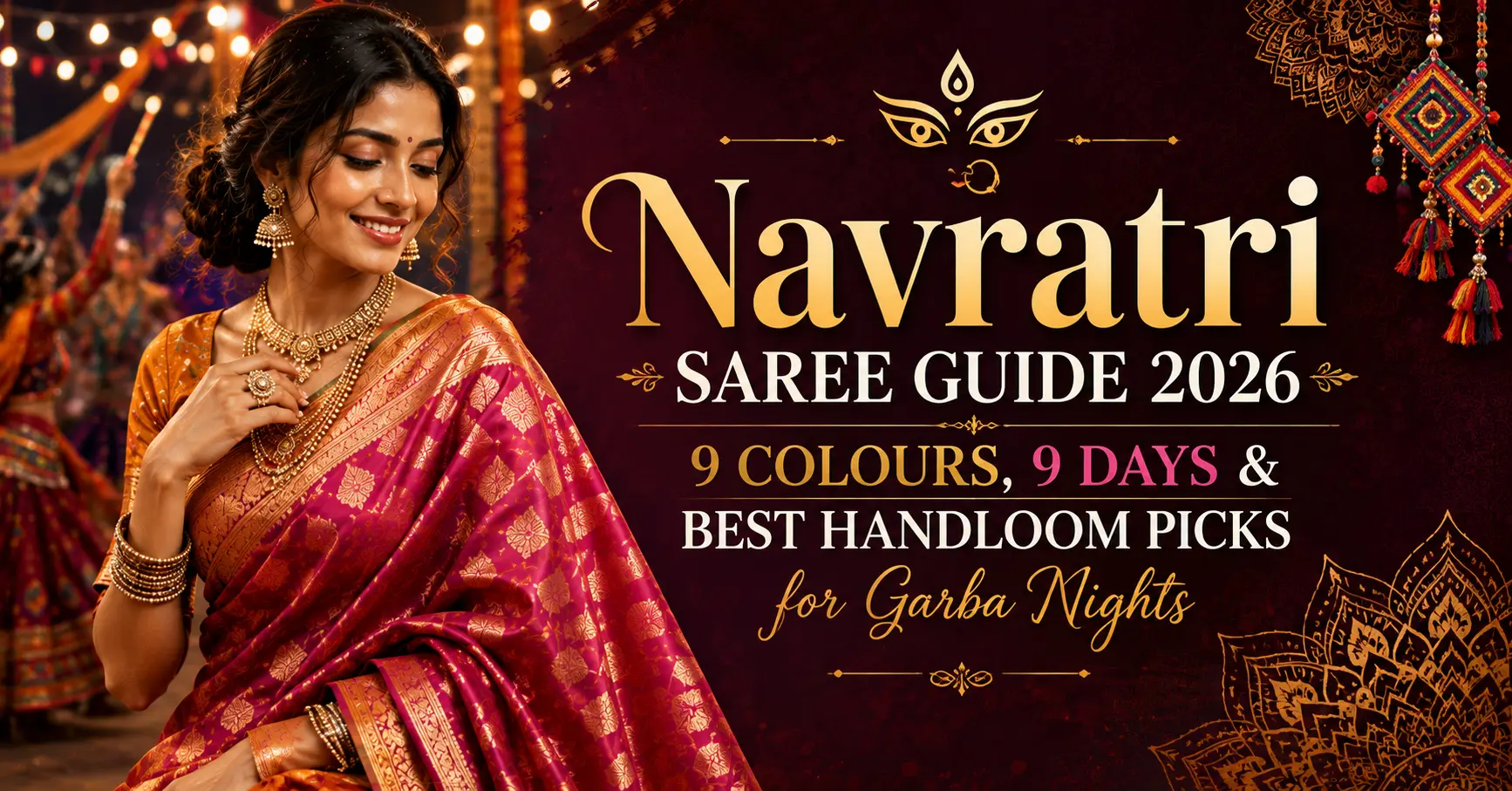
Navratri Saree Guide 2026: 9 Colours, 9 Days & Best Handloom Picks for Garba Nights
Sharad Navratri 2026 runs from Sunday, 11 October to Monday, 19 October, with Vijayadashami (Dussehra) on Tuesday, 20 October. Nine nights of devotion, dance, and colour — and for millions of women across India, nine chances to wear a saree that honours both tradition and personal style.
Each day of Navratri is dedicated to a different form of Goddess Durga and associated with a specific colour. Wearing the day’s colour is believed to channel that Goddess’s divine energy — and it makes choosing your outfit beautifully simple.
This guide gives you the complete 2026 day-by-day colour sequence (which shifts every year based on the starting weekday), handloom saree picks for each colour, and practical tips for garba-ready draping and styling.
Day-by-Day Navratri Colour Guide 2026 with Handloom Saree Picks
Because Navratri 2026 starts on a Sunday, the colour sequence opens with Orange. Here is the complete 9-day plan:
| Day | Date | Colour | Goddess | Handloom Saree Pick |
| Day 1 | Oct 11 (Sun) | Orange | Maa Shailputri | Maheshwari silk in sunset orange or Ajrakh in rust tones |
| Day 2 | Oct 12 (Mon) | White | Maa Brahmacharini | Kerala Kasavu cotton or ivory Chanderi silk-cotton |
| Day 3 | Oct 13 (Tue) | Red | Maa Chandraghanta | Banarasi silk or Paithani in classic red with gold zari |
| Day 4 | Oct 14 (Wed) | Royal Blue | Maa Kushmanda | Ikat cotton or Chanderi silk in royal/navy blue |
| Day 5 | Oct 15 (Thu) | Yellow | Maa Skandamata | Mangalagiri cotton in mustard or Tussar silk in golden yellow |
| Day 6 | Oct 16 (Fri) | Green | Maa Katyayani | Chanderi in emerald green or Maheshwari in bottle green |
| Day 7 | Oct 17 (Sat) | Grey | Maa Kaalratri | Handloom linen in silver-grey or Ikat cotton in ash grey |
| Day 8 | Oct 18 (Sun) | Purple | Maa Mahagauri | Chanderi silk in plum/mauve or Tussar in lavender |
| Day 9 | Oct 19 (Mon) | Peacock Green | Maa Siddhidatri | Paithani in peacock green or Banarasi in teal with gold zari |
Explore our colour-wise guides for help finding the perfect shade: Chanderi saree colour guide and Maheshwari saree colour guide. For the premium red and peacock green nights, see our curated Banarasi and Paithani collections.
Best Handloom Fabrics for Garba & Dandiya Nights
Navratri isn’t just about colour — the fabric matters enormously. You’ll be dancing for hours, often outdoors, in October’s warm transitional weather. Here’s what works:
- Cotton handlooms (best for comfort): Mangalagiri cotton and Ikat cotton are the most garba-friendly fabrics. Lightweight, breathable, and easy to move in. They also wash easily if you’re dancing all nine nights.
- Chanderi cotton-silk (best for elegance + comfort): Chanderi sarees offer the sheen of silk with the breathability of cotton. Perfect for puja evenings and more formal garba events.
- Tussar silk (best for standout nights): For Day 3 (red) and Day 9 (peacock green) when you want to dress up, Tussar silk is lighter than Banarasi but still looks festive and luxurious.
- Georgette & crepe (best for dance floor): These drape fluidly and don’t restrict movement. Ideal for high-energy dandiya raas sessions.
💡 Pro tip: Save your heavy silks (Banarasi, Paithani) for the final two nights and Dussehra. Use lightweight cotton and Chanderi for Days 1–7 to stay comfortable through the entire nine-night stretch.
Navratri Saree Styling – Blouse, Jewellery & Dance-Ready Draping
Blouse ideas:
- Mirror-work blouses are quintessentially Navratri — the sparkle catches light beautifully during garba. Pair with a simple cotton saree to let the blouse be the star.
- For a modern look, try a crop-top blouse or cape-sleeve blouse with a pre-draped saree. Browse our 2026 blouse design guide for more ideas.
Jewellery tips:
- Oxidised silver jhumkas and stacked bangles are the classic Navratri combination — festive, lightweight, and comfortable for dancing.
- Kundan or polki sets work beautifully for the puja evenings. Temple jewellery pairs perfectly with red and green silk sarees.
- Skip heavy necklaces if you’re doing garba — statement earrings and bangles are enough.
Dance-ready draping:
- The seedha (front) pallu drape is the most garba-friendly — the pallu stays in place even during vigorous movement.
- A pre-draped saree eliminates pallu management entirely — perfect for serious dandiya players.
- Pin generously: 5–7 safety pins at pallu, waist, and pleats prevent wardrobe emergencies. See our complete draping guide for step-by-step instructions on secure festive draping.
Smart Wardrobe Planning – 9 Nights Without 9 New Sarees
You don’t need nine brand-new sarees. Here’s how to plan smartly:
- Invest in 3–4 new sarees for the standout nights (Day 1, Day 3, Day 8/9) and mix with what you already own.
- Change the blouse, not the saree: The same saree looks entirely different with a contrast blouse, different jewellery, and a new draping style.
- Borrow and swap: Navratri is a community celebration — swapping sarees with friends and family is both practical and fun.
- Budget-conscious? Mangalagiri cottons and Ikat cottons start at ₹700–₹1,500 and come in every colour. Check our best traditional sarees for weddings and festivals for curated picks across price points.
Celebrate Navratri 2026 in Authentic Handloom
At Shashikala Sarees, our collection covers every Navratri colour — from vibrant orange Maheshwari silks to classic red Banarasi, sunshine yellow Mangalagiri cottons, and peacock green Paithani sarees. Every piece is handwoven by artisans, sourced directly from weaving clusters, and comes with complete transparency on fabric and origin.
After nine nights of celebration, protect your sarees with our handloom saree care and storage guide so they’re ready for next year’s Navratri.
Dance through nine nights in authentic handloom. 🪔
➤ Explore our Navratri-ready handloom collection at ShashikalaSarees.com
FAQ’s
Q1: What are the 9 colours for Navratri 2026?
The Navratri 2026 colour sequence is: Day 1 – Orange, Day 2 – White, Day 3 – Red, Day 4 – Royal Blue, Day 5 – Yellow, Day 6 – Green, Day 7 – Grey, Day 8 – Purple, Day 9 – Peacock Green. The sequence starts with orange because Navratri 2026 begins on a Sunday.
Q2: When is Navratri 2026?
Sharad Navratri 2026 runs from Sunday, 11 October to Monday, 19 October 2026. Vijayadashami (Dussehra) falls on Tuesday, 20 October 2026.
Q3: What saree fabric is best for garba nights?
Lightweight cotton handlooms (Mangalagiri, Ikat cotton) and cotton-silk blends (Chanderi) are the best for garba because they are breathable, easy to move in, and don’t restrict dance movements. Save heavier silk sarees for puja evenings and the final nights.
Q4: Do I need 9 different sarees for Navratri?
No. You can plan smartly with 3–4 sarees by changing your blouse, jewellery, and draping style each night. You can also mix sarees you already own with a few new purchases for the standout nights (Day 1, Day 3, and Day 9).
Q5: Which Navratri night should I wear my best saree?
Day 3 (Red – Maa Chandraghanta) and Day 9 (Peacock Green – Maa Siddhidatri) are traditionally the most significant nights. Day 8 (Durga Ashtami) is also a major puja night. Save your premium silk sarees for these occasions.
EXTERNAL LINKS TO ADD (Open in New Tab)
- Drik Panchang – Navratri 2026 Dates & Colours — https://www.drikpanchang.com/navratri/colors/navratri-nine-colors.html
- India Handloom Brand Portal — https://handlooms.nic.in


About author



Add comment