
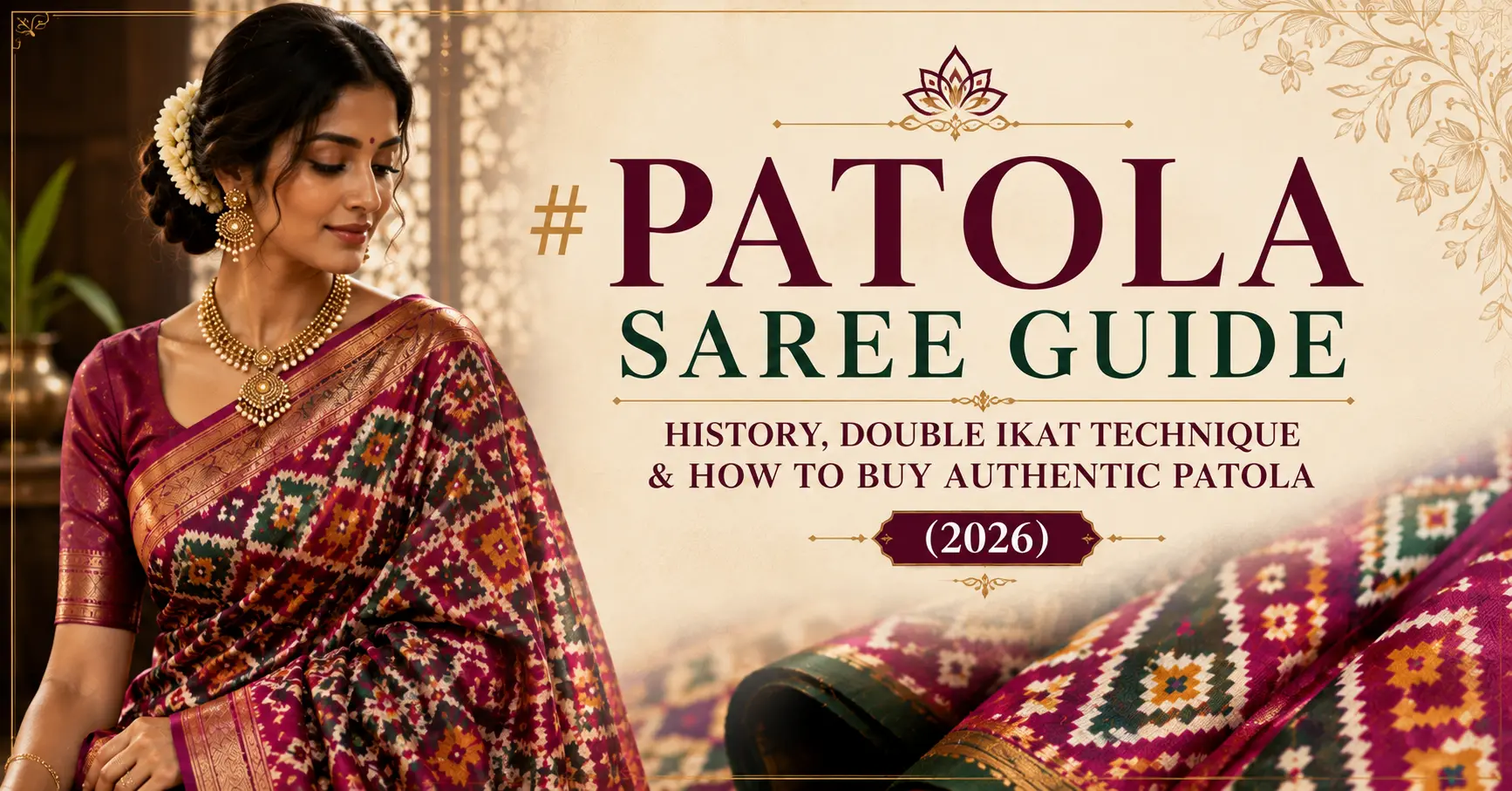
Patola Saree Guide: History, Double Ikat Technique & How to Buy Authentic Patola (2026)
QUICK FACTS
- Origin: Patan, Gujarat (900+ year tradition)
- Technique: Double ikat — both warp and weft threads resist-dyed before weaving
- GI Status: Geographical Indication certified
- Time per saree: 6 months to 1 year (Patan double ikat)
- Weaving family: Salvi family of Patan — among the last custodians of the craft
- Price range: ₹12,000 (Rajkot single ikat) to ₹3,00,000+ (Patan double ikat)
If the world of Indian handloom sarees had a crown jewel, it would be the Patan Patola. A single saree can take two weavers up to a year to complete. It was the cloth of kings and queens — so prized that it travelled the ancient spice routes to Indonesia, where Patola became sacred heirloom textiles in their own right.
Yet the word “Patola” is also one of the most misused terms in the Indian saree market. Printed copies, machine-made imitations, and single-ikat versions are all sold under the same name, with prices ranging from ₹3,000 to ₹3,00,000. Without understanding the craft behind it, buyers have no way to know what they’re actually paying for.
This guide covers the history of Patola, the difference between Patan and Rajkot Patola, how to identify authentic pieces, realistic pricing, and how to style this extraordinary textile.
What Is Patola? The Double Ikat Technique Explained
Patola is a handwoven silk saree made using the ikat technique — a resist-dyeing process where threads are tied and dyed to the final pattern before they are placed on the loom. The design exists in bundles of loose yarn before a single thread is woven.
What makes Patan Patola extraordinary is that it uses double ikat — meaning both the warp (vertical) and weft (horizontal) threads are individually resist-dyed to the exact design. During weaving, these pre-dyed threads must be aligned intersection by intersection, with microscopic precision, to produce the final pattern. Even a single misalignment would distort the entire design.
The result is a saree that is fully reversible — the front and back look virtually identical. This reversibility is the hallmark of true double ikat and is the simplest way to distinguish genuine Patola from imitations.
If you’re familiar with Pochampally Ikat sarees from Telangana, note that most Pochampally is single ikat (only the weft is dyed). Patan Patola takes the same foundational technique and elevates it to an extreme level of complexity.
Patan Patola vs Rajkot Patola – Understanding the Difference
This is the most important distinction for any Patola buyer. Both are authentic handloom sarees from Gujarat, but the technique, effort, and price are vastly different:
| Parameter | Patan Patola (Double Ikat) | Rajkot Patola (Single Ikat) |
| Technique | Double ikat — both warp & weft resist-dyed | Single ikat — only weft resist-dyed |
| Reversibility | Fully reversible (front = back) | Front is sharp; back is slightly blurred |
| Time per saree | 6 months to 1 year | 2–6 weeks |
| Weavers | Salvi family (Patan) — fewer than 10 active looms | Multiple weaving families in Rajkot |
| Design style | Intricate, subtle geometric precision | Bolder, more vibrant colour combinations |
| GI tag | Yes — GI certified | Not GI-tagged separately |
| Price range | ₹80,000 – ₹3,00,000+ | ₹8,000 – ₹40,000 |
Neither is “better” than the other — they serve different purposes. Rajkot Patola is a beautiful, wearable handloom silk at accessible prices. Patan Patola is a museum-grade textile and a once-in-a-lifetime investment. What matters is that you know which one you’re buying and paying for. For more on how GI certification works, read our GI-tagged sarees of India guide.
How to Identify an Authentic Patola Saree
The Patola market is flooded with printed imitations and mislabelled sarees. Here’s how to verify what you’re buying:
- The Flip Test (most reliable): Turn the saree over. In genuine double ikat Patola, the design on the reverse is virtually identical to the front. In single ikat, the reverse is slightly less sharp. In printed copies, the reverse is completely flat or blank.
- Check the edges: Like all handlooms, authentic Patola has slightly uneven selvedge with natural thread loops. Machine-made copies have perfectly uniform, clean-cut edges.
- Examine thread transitions: In genuine ikat, colour transitions have a slight feathered or ‘bleeding’ effect where one colour meets another — this is the natural result of resist-dyeing. Printed copies have sharp, clean colour boundaries.
- Ask for documentation: Genuine Patan Patola from the Salvi family or authorised dealers comes with a certificate of authenticity. Rajkot Patola from certified weavers carries a Silk Mark tag.
- Price reality check: If someone is selling a “double ikat Patan Patola” for ₹10,000, it is not genuine. Real Patan Patola starts at approximately ₹80,000. Use our handloom saree price guide for fair pricing benchmarks, and our guide to identifying genuine handloom sarees for a complete authenticity checklist.
Patola Saree Price Range – What to Expect in 2026
The Patola market has four clear pricing tiers:
| Tier | Type | Price Range | What You Get | Watch Out For |
| 1 | Patola Print | ₹2,000–₹5,000 | Printed pattern on silk or synthetic base | Not handwoven; no ikat; decorative only |
| 2 | Rajkot Single Ikat | ₹8,000–₹40,000 | Genuine handwoven single ikat silk | Honest sellers label it as single ikat |
| 3 | Premium Rajkot | ₹40,000–₹80,000 | Intricate single ikat with zari work | May be sold as ‘double ikat’ — verify |
| 4 | Patan Double Ikat | ₹80,000–₹3,00,000+ | True double ikat, fully reversible, heirloom | Buy only from Salvi family or authorised dealers |
The biggest pricing trap is the ₹30,000–₹70,000 range, where premium Rajkot single ikat is sometimes mislabelled as double ikat Patan Patola. Always apply the flip test and ask for documentation. Understanding zari quality also helps you judge whether the zari work justifies the quoted price.
How to Style Patola for Different Occasions
- Weddings & grand events: Patola is a bridal-grade saree in Gujarat. A red or maroon Patola with gold accents, paired with traditional Gujarati jewellery (rani haar, jhumkas, gold bangles), is the ultimate statement. See our best traditional sarees for weddings for more premium picks.
- Festive occasions: Rajkot Patola in vibrant colours (green, pink, blue) works beautifully for Navratri, Diwali, and family celebrations. The geometric patterns look festive without being overdone.
- Formal events: A subtle Patola in muted tones (ivory, ash, teal) with minimal jewellery creates an effortlessly sophisticated look for art exhibitions, formal dinners, and cultural events.
- Everyday luxury: Mid-range Rajkot Patola works for semi-formal office events and brunch outings. Pair with a modern blouse design and contemporary draping to keep the look current.
Patola vs Pochampally Ikat – Quick Comparison
Both are ikat sarees, but they come from different traditions. Here’s how they compare:
- Patola (Gujarat): Pure silk, geometric patterns, resist-dyed threads, fully reversible (double ikat). Premium heirloom textile.
- Pochampally (Telangana): Silk or cotton, bold geometric patterns, typically single ikat (some double). More affordable and accessible. Read our Ikat cotton vs silk guide and Pochampally authenticity guide for more details.
Both are GI-tagged, both are gorgeous — they simply occupy different price and prestige segments of the Indian handloom market.
Explore Heritage Handlooms at Shashikala Sarees
Patola represents the pinnacle of Indian weaving. At Shashikala Sarees, while we don’t carry genuine Patan double ikat (very few can at those price points), our collection celebrates the same ikat heritage through authentic Pochampally Ikat and handwoven sarees from India’s finest weaving traditions — Banarasi, Paithani, Chanderi, Maheshwari, and more.
Protect your premium silk investments with our handloom saree care and storage guide — because a saree this precious deserves to last generations.
➤ Explore our heritage handloom collection at ShashikalaSarees.com
FAQ’s
Q1: What is the difference between Patan Patola and Rajkot Patola?
Patan Patola uses the double ikat technique where both warp and weft threads are resist-dyed before weaving, resulting in a fully reversible saree. It takes 6 months to a year per saree. Rajkot Patola uses single ikat where only the weft is dyed, taking 2–6 weeks. Patan Patola starts at approximately ₹80,000 while Rajkot Patola ranges from ₹8,000 to ₹40,000.
Q2: How can I tell if a Patola saree is genuine?
The flip test is the most reliable method. Turn the saree over — in genuine double ikat, the back looks almost identical to the front. Also check for natural ikat ‘bleeding’ at colour transitions (printed copies have sharp boundaries), uneven handloom selvedge, and ask for a certificate of authenticity or Silk Mark tag.
Q3: Why are Patola sarees so expensive?
The price reflects the extraordinary labour involved. In double ikat, every single thread must be individually tied and dyed to the exact pattern before weaving begins, then aligned with microscopic precision on the loom. A single Patan Patola saree can occupy two weavers for 6–12 months. The skill is so specialised that fewer than a handful of families in the world can still produce it.
Q4: Is Patola saree a good investment?
Genuine Patan Patola sarees appreciate in value over time due to their rarity and declining number of active weavers. They are considered textile heirlooms and are frequently passed down through generations. Rajkot Patola, while not an ‘investment piece’ in the same sense, is a beautiful, durable handloom silk that offers excellent long-term value for its price.
Q5: What is the difference between Patola and Pochampally Ikat?
Both use the ikat resist-dyeing technique, but Patola comes from Gujarat (primarily Patan and Rajkot) and is traditionally woven in pure silk with geometric patterns. Pochampally comes from Telangana and is available in both silk and cotton with bolder designs. Patan Patola is double ikat (the rarest form), while most Pochampally is single ikat. Patola is significantly more expensive than Pochampally.


About author



Add comment