
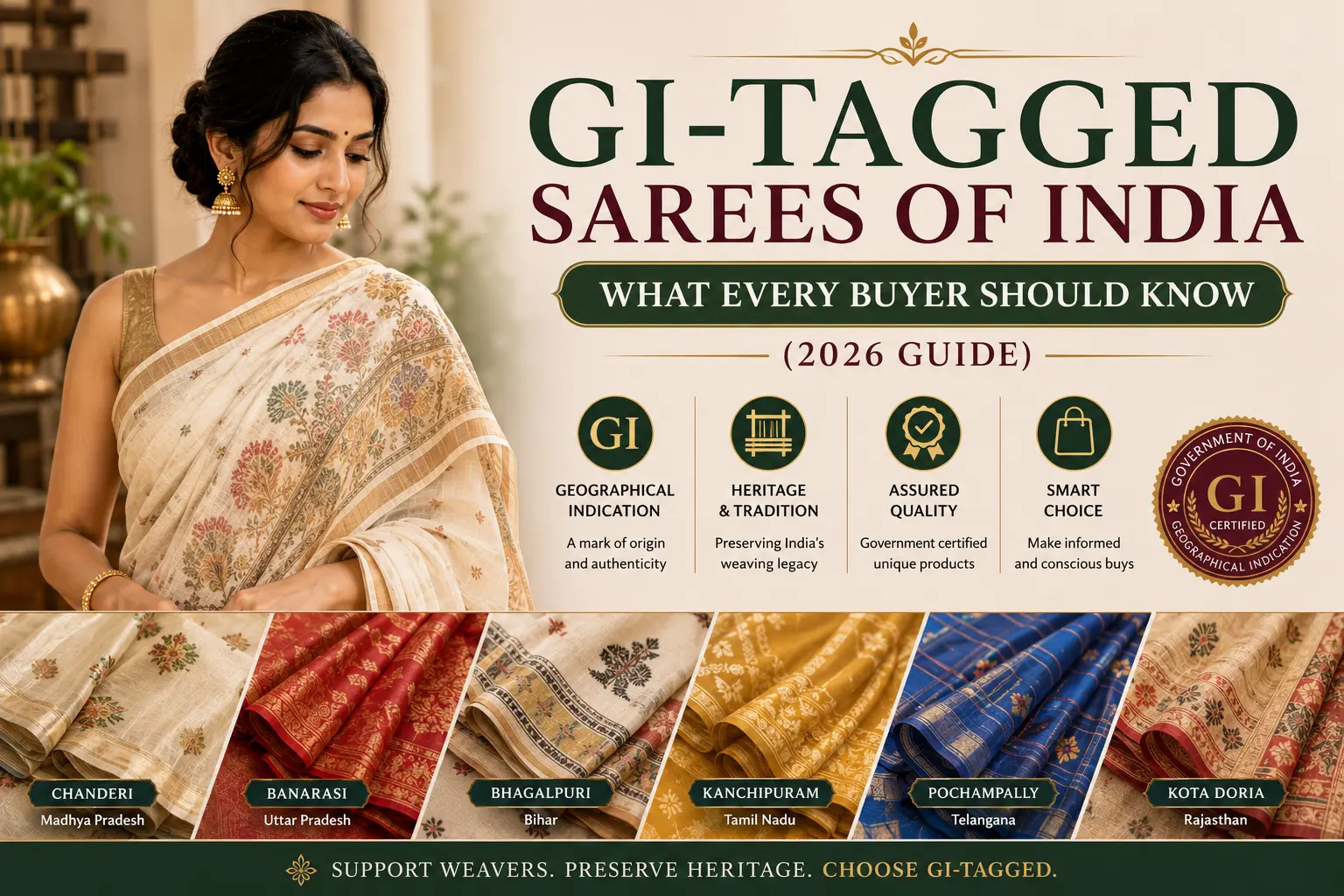
GI-Tagged Sarees of India – What Every Buyer Should Know (2026 Guide)
India’s handloom sarees carry centuries of regional artistry from the golden zari of a Banarasi saree to the peacock motifs of a Paithani saree. But how do you know the saree you’re buying is genuinely handwoven in its region of origin and not a mass-produced imitation?
That’s where the Geographical Indication (GI) tag comes in. A GI tag is a government-issued certification that legally links a product to its specific region of origin and traditional method of production. For saree buyers, it is one of the most reliable markers of authenticity.
In this guide, we break down everything you need to know about GI-tagged sarees in India what GI means, which sarees hold this certification, how to verify it, and why it matters for your next purchase.
How GI Tags Protect India’s Handloom Heritage
A Geographical Indication (GI) tag is a form of intellectual property protection governed in India under the Geographical Indications of Goods (Registration and Protection) Act, 1999. It is administered by the GI Registry under the Department for Promotion of Industry and Internal Trade (DPIIT).
When a saree receives a GI tag, it means:
- Only weavers from the designated region can produce and sell sarees under that registered name.
- The saree must follow the traditional weaving methods, materials, and design motifs specific to that region.
- It provides legal protection against counterfeits and mass-produced imitations using the same name.
- It supports the livelihoods of artisan communities by ensuring their craft retains market value. Learn more about how identifying genuine handloom sarees protects this heritage.
As of 2026, India has over 650 registered GI tags across categories, with handloom textiles forming one of the largest groups. For anyone who values authentic handloom sarees, understanding GI certification is essential.
Complete List of GI-Tagged Sarees in India (State-Wise)
Below is a curated list of some of India’s most iconic GI-tagged sarees, organised by state. Each of these sarees carries a legally protected identity tied to its region and weaving tradition.
| Saree Name | State | Key Fabric | Known For |
| Banarasi Saree | Uttar Pradesh | Pure Silk + Zari | Mughal-era brocade patterns, bridal grandeur |
| Kanchipuram Silk | Tamil Nadu | Mulberry Silk | Heavy zari borders, temple weaving tradition |
| Paithani Saree | Maharashtra | Pure Silk + Gold Zari | Peacock pallu motifs, Peshwa-era heritage |
| Chanderi Saree | Madhya Pradesh | Silk-Cotton Blend | Sheer texture, lightweight elegance |
| Maheshwari Saree | Madhya Pradesh | Cotton / Silk Blend | Reversible borders, royal Holkar origins |
| Pochampally Ikat | Telangana | Silk / Cotton Ikat | Double ikat tie-dye technique |
| Patola Saree | Gujarat | Pure Silk Double Ikat | Geometric precision, 6–12 months per saree |
| Sambalpuri Saree | Odisha | Silk / Cotton Ikat | Shankha-chakra motifs, bandha tie-dye |
| Jamdani Saree | West Bengal | Fine Muslin Cotton | UNESCO-recognised supplementary weft weaving |
| Tussar Silk | Jharkhand / Bihar | Wild Tussar Silk | Natural golden sheen, eco-friendly |
| Mangalagiri Saree | Andhra Pradesh | Cotton | Nizam-dot patterns, lightweight daily wear |
| Kota Doria | Rajasthan | Cotton-Silk Blend | Open-weave checkered khat pattern |
| Ilkal Saree | Karnataka | Cotton + Silk Pallu | Distinctive tope-teni pallu joining technique |
| Muga Silk | Assam | Wild Muga Silk | Golden lustre, exclusive to Assam |
Many of these heritage sarees are available at Shashikala Sarees. Explore our detailed guides on Chanderi sarees, Maheshwari silk sarees, Ikat sarees, Ajrakh sarees, Jamdani sarees, Tussar silk sarees, and Mangalagiri cotton sarees to learn more about each weave.
This is not an exhaustive list — India has dozens of other GI-certified textiles including Ajrakh prints, Kalamkari, Baluchari, Bomkai, and more. The sarees listed above represent the most widely purchased and searched-for GI-tagged handlooms.
How to Verify if Your Saree Has a Genuine GI Tag
Knowing that a saree category holds GI certification is helpful, but the real question is: how do you verify that the specific saree you’re buying is genuinely GI-certified? Here is a practical checklist:
- Look for the Handloom Mark or Silk Mark: The Government of India issues these labels through the Textile Ministry. A genuine handloom saree often carries a Handloom Mark tag attached to the fabric.
- Check for weaver cooperative labels: Many GI-registered sarees are sold through recognised weaver cooperatives (like Banaras Bunkar Samiti or Chanderi Weavers Cooperative). These labels indicate origin and authenticity.
- Examine the saree’s selvedge (border edge): Handloom sarees have slightly uneven, natural selvedge. Powerloom copies have perfectly uniform, machine-cut edges. Our guide on how to identify genuine handloom sarees covers this in detail.
- Ask for a certificate of authenticity: Reputed sellers provide certificates mentioning the weaver’s name, region of origin, and fabric composition.
- Verify on the GI Registry: You can check whether a product category holds GI certification at the official Intellectual Property India portal (ipindia.gov.in).
Does a GI Tag Guarantee Authenticity? What It Does & Doesn’t Cover
A GI tag is a powerful trust signal, but it is important to understand its scope clearly.
What a GI tag DOES:
- Legally confirms that the saree type originates from a specific geographical region.
- Protects the registered name from being used by unauthorised producers outside that region.
- Ensures the saree is made using recognised traditional methods and materials.
What a GI tag DOES NOT do:
- It does not certify every individual saree. The GI applies to the product category, not to each piece.
- It does not replace physical quality checks. You still need to inspect fabric weight, zari quality, and weave tightness. Our Banarasi saree buying guide walks you through these checks step by step.
- It does not guarantee a specific price point. Two GI-tagged Chanderi sarees can differ significantly in quality and cost. See our handloom saree price guide for fair pricing benchmarks.
The takeaway: a GI tag tells you what the saree is and where it comes from. Ensuring the quality of the specific piece still requires a trusted seller.
Why Buying GI-Tagged Sarees Supports Weavers Directly
When you choose a GI-tagged handloom saree, you are doing more than buying a beautiful garment. You are investing in a living tradition.
- GI protection ensures that only artisans in the original weaving cluster benefit from the demand for that saree name, preventing large factories from undercutting them with cheap copies.
- It keeps traditional weaving techniques alive. When there is fair demand for authentic handlooms, the next generation of weavers has a reason to learn and continue the craft.
- GI-tagged sarees carry higher perceived and resale value, which directly translates into better income for weaver families and cooperatives. Taking proper care of your handloom sarees helps preserve both their value and the tradition behind them.
According to the Ministry of Textiles, India’s handloom sector employs over 31 lakh weavers and allied workers. Every authentic handloom purchase contributes directly to this ecosystem.
Shop Heritage Handlooms at Shashikala Sarees
At Shashikala Sarees, we believe every saree should tell a genuine story. Our collection includes handloom sarees from India’s most respected weaving traditions — Paithani, Chanderi, Banarasi, Maheshwari, Ikat, Ajrakh, Mangalagiri, Tussar, and Jamdani — sourced directly from artisan clusters and weaver cooperatives.
When you shop with us, you get complete transparency on origin, fabric composition, and weaving method. Every saree honours India’s GI-protected handloom traditions.
➤ Explore our authentic handloom saree collection at ShashikalaSarees.com
FAQ’s
Q1: What does GI tag mean on a saree?
A GI (Geographical Indication) tag on a saree means the product is legally recognised as originating from a specific region in India and is made using traditional methods unique to that area. It protects the saree’s identity from counterfeits and ensures buyers receive an authentic regional handloom.
Q2: Which Indian sarees have a GI tag?
Some of the most well-known GI-tagged sarees include Banarasi (Uttar Pradesh), Kanchipuram Silk (Tamil Nadu), Paithani (Maharashtra), Chanderi (Madhya Pradesh), Maheshwari (Madhya Pradesh), Pochampally Ikat (Telangana), Patola (Gujarat), Sambalpuri (Odisha), Jamdani (West Bengal), and Tussar Silk (Jharkhand/Bihar), among many others.
Q3: How can I check if a saree is GI-tagged?
Look for the Handloom Mark or Silk Mark label, check for weaver cooperative tags, examine the selvedge for handloom irregularities, ask for a certificate of authenticity, and verify the product category on the official GI Registry at ipindia.gov.in.
Q4: Does a GI tag guarantee quality?
A GI tag guarantees geographical origin and traditional production method, but it does not certify the quality of every individual saree. Two GI-tagged sarees of the same type can differ in quality based on thread count, zari purity, and weaver expertise. Buying from a reputed seller remains important.
Q5: Why are GI-tagged sarees more expensive?
GI-tagged sarees are typically handwoven using traditional techniques that require significant time, skill, and premium raw materials. A single Patola or Paithani saree can take months to complete. The higher price reflects genuine craftsmanship, fair artisan wages, and the heritage value of the product.
EXTERNAL LINKS TO ADD (Open in New Tab)
- GI Registry of India — https://ipindia.gov.in/gi.htm
- Ministry of Textiles Handloom Portal — https://handlooms.nic.in


About author



Add comment