
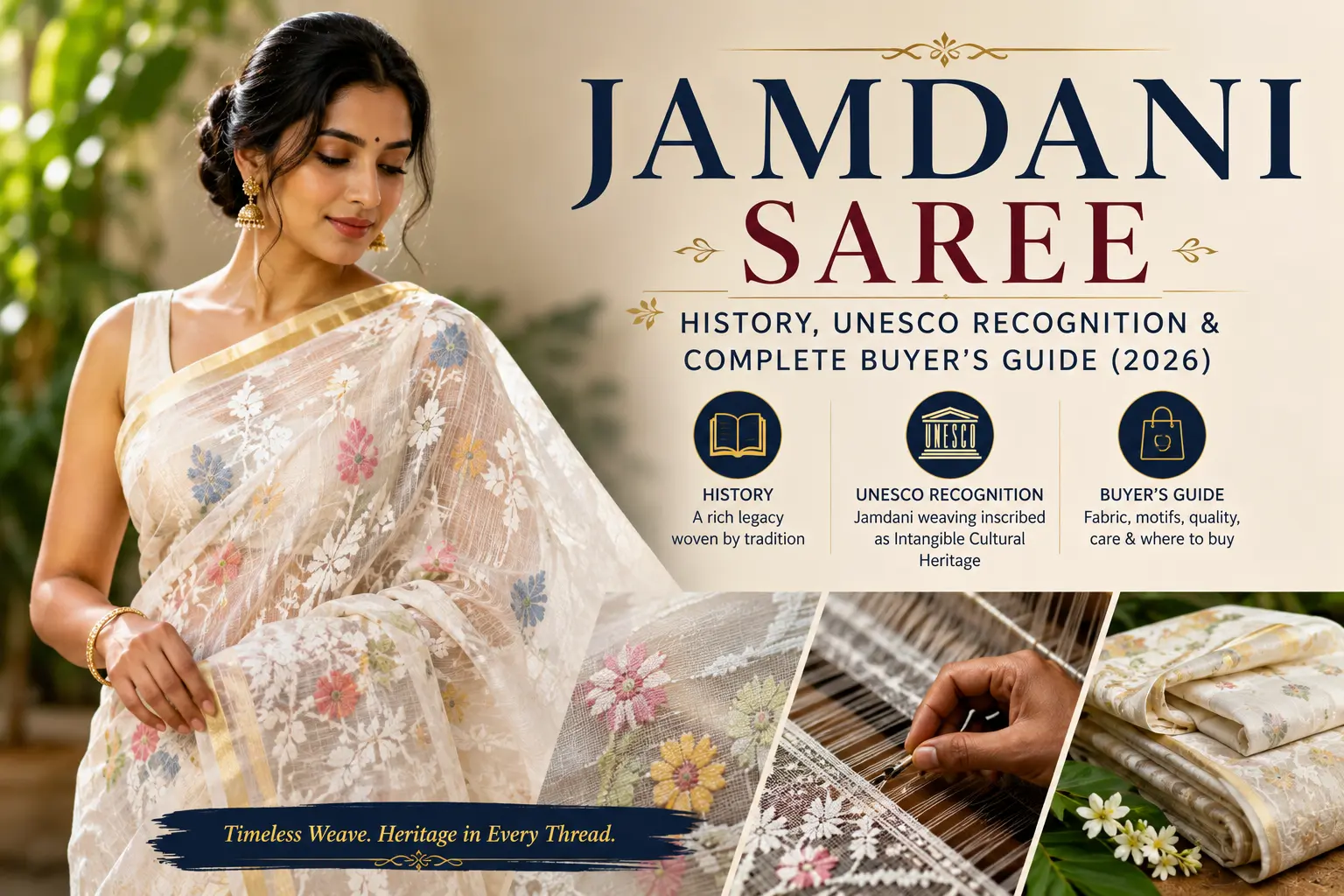
Jamdani Saree: History, UNESCO Recognition & Complete Buyer’s Guide (2026)
Imagine a fabric so impossibly fine that Mughal emperors considered it a sign of divine craftsmanship. So light, so sheer, that European traders once said it looked like running water — or simply called it ‘woven air’. That fabric was Jamdani, and more than four centuries later, it remains one of the most extraordinary handloom traditions in the world.
In 2013, UNESCO made it official: the traditional art of Jamdani weaving was inscribed on the Representative List of the Intangible Cultural Heritage of Humanity. For buyers today, that recognition is not just a badge — it is a reminder that every Jamdani saree you wear connects you to a living, breathing craft heritage that the world has agreed is worth protecting.
Whether you are a first-time buyer, a seasoned saree collector, or someone researching a meaningful gift, this guide covers everything — history, types, motifs, prices, and how to tell the real thing from an imitation.
| Quick Fabric Facts: Jamdani Saree at a Glance
• Also known as: Dhakai saree, muslin saree, Bengali handloom saree • UNESCO status: Inscribed 2013 — Representative List of Intangible Cultural Heritage of Humanity • GI Tag: Bangladesh (2016); Uppada Jamdani — Andhra Pradesh, India • Technique: Discontinuous supplementary weft — motifs woven directly on loom, not printed • Weaving time: Weeks to 3 years depending on complexity • Origin clusters (India): Shantipur & Dhaniakhali (West Bengal), Uppada (Andhra Pradesh) • Base fabric: Fine cotton (muslin) or silk • Best for: Pujas, weddings, daily formal wear, gifting |
What Is Jamdani? The Weave That Defied Gravity
Jamdani is not just a saree style — it is a technique. The word comes from Persian: ‘Jama’ meaning cloth and ‘dana’ meaning small granule, referring to the dotted appearance of the motifs scattered across the sheer base fabric.
What makes Jamdani unique is its discontinuous supplementary weft technique. Unlike most woven fabrics where the design thread runs the full width of the loom, Jamdani weavers insert extra threads only where the motif appears — using a thin horn tool called a kandul to lift individual warp threads by hand and weave the supplementary thread through. The result: motifs that appear to float on the surface of the fabric, as if suspended in air rather than woven into it.
No sketch is drawn on the fabric beforehand. Weavers work from graph paper placed under the warp threads, recreating each motif from memory and skill. Two weavers typically sit side by side at a single loom. A complex Jamdani saree can take anywhere from six weeks to three years to complete.
Top 5 Handloom Sarees Trending in India — Style Tips & Inspiration
From Mughal Courts to Your Wardrobe — A Brief History
The earliest written record of Jamdani dates to the reign of Mughal Emperor Jahangir (1605–1627), who wore a sash woven with Jamdani floral designs. At the Mughal court, Dhaka muslin — the finest Jamdani base fabric — was so precious it was available only to royalty. Stories describe fabric so fine it was called ‘woven air’, ‘running water’, and ‘morning dew’ by traders who encountered it.
During the British colonial period, the industrialisation of textile manufacturing devastated the handloom sector across India and Bengal. Jamdani nearly went extinct — many weavers abandoned the craft for lack of patronage and fair wages.
The revival came in two waves. After the Partition of Bengal in 1947, Hindu weavers from Dhaka resettled in West Bengal — particularly in Shantipur and Dhaniakhali — bringing the tradition to Indian soil. Decades later, government initiatives, weaver cooperatives, and growing consumer appreciation for handloom crafts created the second revival that continues today.
| External Reference: UNESCO Intangible Cultural Heritage — View UNESCO’s official Jamdani inscription page → |
Why UNESCO Inscribed Jamdani in 2013 — and What It Means for Buyers
UNESCO’s inscription of the traditional art of Jamdani weaving in 2013 was recognition of several overlapping realities: the extraordinary skill required, the centuries of unbroken tradition, and the very real risk of the craft being lost to industrialisation.
For buyers, the UNESCO recognition carries a specific meaning: what you are buying cannot be replicated by machines without losing its essential character. The motifs woven into a genuine Jamdani cannot be achieved with the same visual depth by printing or embroidery. The slight irregularities, the barely perceptible three-dimensionality of each motif, and the translucency of the base fabric are the direct result of human hands working at the limits of their skill.
In 2016, Bangladesh received a Geographical Indication (GI) tag for Jamdani sarees. India holds GI protection for Uppada Jamdani saree from Andhra Pradesh. Both certifications protect the geographic origin and production method of authentic pieces.
| External Reference: GI Registry, Intellectual Property India — Search ‘Uppada Jamdani’ on the GI Registry India → |
Types of Jamdani Sarees — Dhakai, Tangail, Shantipur, Dhaniakhali & Uppada
Jamdani is not a single regional product — it is a weaving tradition that has taken root in several clusters across Bengal and coastal Andhra Pradesh. Each origin produces a distinct character:
| Jamdani Type | Origin | Key Feature | Best For |
| Dhakai Jamdani | Dhaka, Bangladesh | Finest thread count; dense floral & geometric motifs; most prestigious variety | Special occasions, weddings, heirloom gifting |
| Tangail Jamdani | Tangail district, Bangladesh | Bold borders with lotus, fish scale & lamp motifs; wider patterns | Festivals, durga puja, formal functions |
| Shantipur Jamdani | Shantipur, West Bengal | Elegant stripes and checks; lighter weave than Dhakai | Daily festive wear, office formals |
| Dhaniakhali Jamdani | Dhaniakhali, West Bengal | Bold colours with dark contrasting borders; tightly woven | Everyday elegance, casual celebrations |
| Uppada Jamdani | Uppada, Andhra Pradesh | GI-tagged; lightweight transparent weave; silk or cotton base | South Indian weddings, formal occasions |
Best Traditional Sarees for Weddings & Festivals in India
Jamdani Motifs Decoded — What Each Pattern Means
One of the greatest pleasures of owning a Jamdani saree is understanding what is actually woven into it. Traditional Jamdani motifs carry names and meanings passed down through weaving communities for centuries:
- Panna Hajar (Thousand Emeralds):The rarest and most complex design — thousands of tiny diamond-shaped motifs covering the entire saree body. A single Panna Hajar saree can take years to complete and represents the pinnacle of Jamdani craftsmanship.
- Kalka (Paisley):The teardrop or mango motif, universal across Indian textiles. In Jamdani, it appears with remarkable delicacy as a floating, three-dimensional element.
- Butidar (Small Flowers):An all-over pattern of tiny floral motifs scattered evenly across the saree body — the most common traditional design, elegant and wearable for both daily and festive occasions.
- Jalar (Net Pattern):Motifs covering the entire saree in a lattice arrangement. Creates a rich, dense appearance ideal for formal and ceremonial wear.
- Duria (Polka Dots):Simple circular motifs — deceptively difficult to weave with perfect consistency across a full saree. A classic for understated elegance.
- Charkona (Rectangular Motifs):Geometric rectangular patterns arranged in rows. Popular in Shantipur and Dhaniakhali varieties; gives a structured, architectural quality to the drape.
- Tersa (Diagonal Patterns):Diagonal geometric lines woven across the body, creating an optical movement distinctive to Bengali handloom traditions.
How to Identify a Genuine Jamdani Saree
The growing popularity of Jamdani has unfortunately attracted many imitations — printed cottons and powerloom fabrics sold under the Jamdani name. Here are five reliable tests for authenticity:
- The Reverse Test
Turn the saree inside out. On a genuine handloom Jamdani, the reverse side will show the supplementary weft threads floating loosely between the motif points — similar to the front but slightly rougher. A printed or machine-made imitation will show no thread variation on the reverse.
- The Light Test
Hold the saree up to a light source. Genuine Jamdani — especially cotton muslin-based varieties — should be noticeably translucent or sheer. Motifs will appear as slightly denser areas within the fabric. A powerloom copy will typically be uniform and opaque.
- The Texture Test
Run your fingers lightly over the motifs. Genuine Jamdani motifs feel slightly raised and three-dimensional — the supplementary weft creates a subtle embossed effect. Printed Jamdani motifs feel completely flat, no different from the base fabric.
- The Price Test
A genuine handloom cotton Jamdani in India starts at approximately Rs. 3,000–5,000. Silk Jamdani begins around Rs. 8,000. Pure Dhakai pieces begin at Rs. 25,000+. If a ‘Jamdani saree’ is offered below these thresholds, it is almost certainly machine-made or synthetic.
- Certification Marks
Look for the India Handloom Mark or, for Uppada pieces, the GI tag certification. Reputable sellers will be able to tell you the specific weaving cluster the saree comes from and the approximate weaving time.
How to Identify Genuine Handloom Sarees — Complete Guide
Cotton vs Silk Ikat Sarees — Fabric Comparison Guide
Jamdani Saree Price Range 2026 — What to Expect
Jamdani pricing is driven by four factors: thread count, motif density and complexity, regional origin, and whether the base fabric is cotton or silk. Here is an honest 2026 breakdown:
| Jamdani Type | Price Range (INR) | What You Get |
| Soft Cotton Jamdani (entry) | Rs. 3,000 – Rs. 6,000 | Light handloom cotton, simple butidar motifs, Shantipur or Dhaniakhali origin |
| Mid-range Cotton Jamdani | Rs. 6,000 – Rs. 12,000 | Denser motif coverage, finer cotton count, Tangail-style borders or jalar patterns |
| Silk Jamdani / Uppada | Rs. 8,000 – Rs. 40,000 | GI-tagged Uppada or silk-cotton blend; richer sheen; ideal for weddings and ceremonies |
| Pure Dhakai Jamdani | Rs. 25,000 – Rs. 2,00,000+ | Finest muslin, densest motif work, authentic heritage pieces |
| ⚠️ Price reality check: If a saree is labelled ‘pure Jamdani’ or ‘Dhakai Jamdani’ and priced below Rs.3,000, it is being sold deceptively. The weaving labour alone makes this impossible. Choose transparent sellers who disclose the weaver cluster and thread count. |
How to Style & Care for Your Jamdani Saree
Styling by Occasion
- Daily festive / office formal:A Shantipur or Dhaniakhali cotton Jamdani in a soft stripe or butidar pattern with a contrasting silk blouse. Minimalist gold jewellery. Effortless and appropriate.
- Puja / religious occasions:Off-white or cream Jamdani with red or gold butidar motifs — the traditional Bengali puja combination. Pair with a matching or deep red blouse.
- Wedding as guest:A Tangail Jamdani with wide lotus border in a jewel tone — deep green, wine, or indigo. Antique gold jewellery complements the earthy base perfectly.
- Gifting:A Dhakai or Uppada Jamdani boxed with a care card is one of the most thoughtful and prestigious saree gifts possible — particularly for mothers, mothers-in-law, or significant occasions.
Care Instructions
- Dry clean recommended for pure Dhakai and silk Jamdani pieces
- Cotton Jamdani: gentle cold water hand wash with mild detergent — never machine wash
- Do not wring or twist — gently press water out and roll in a dry towel to absorb moisture
- Dry flat in shade; direct sunlight can fade natural dyes
- Store wrapped in white muslin — never plastic — in a cool, ventilated space
- Refold every 3 months to prevent permanent crease lines along fold edges
Shop Handloom Jamdani Sarees — Shashikala Collection
Conclusion: A Saree Worth Its UNESCO Inscription
A Jamdani saree is not merely a garment. It is the physical record of a weaver’s skill — hours, days, sometimes months of focused, meditative work condensed into every square centimetre of floating motifs. UNESCO recognised this in 2013. Buyers who choose genuine Jamdani are choosing to be part of that recognition in the most direct way possible: by sustaining the demand that keeps the tradition alive.
Whether you are drawn to the fine geometry of a Shantipur cotton Jamdani or the extraordinary density of a pure Dhakai piece, one thing holds true across all varieties: no two Jamdani sarees are identical. The irregularities are not flaws — they are the signature of a human hand.


About author



Add comment