
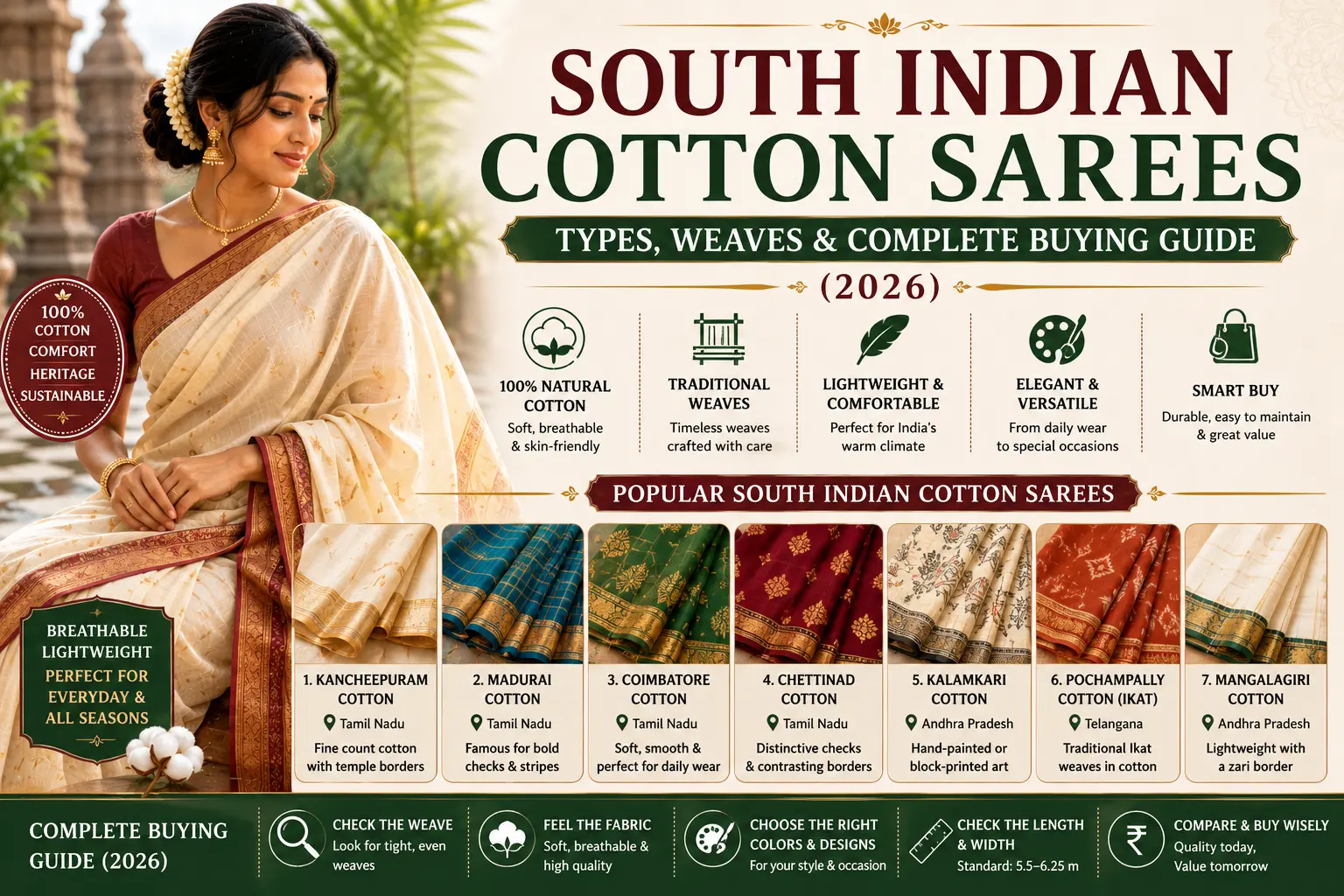
South Indian Cotton Sarees – Types, Weaves & Complete Buying Guide (2026)
If handloom silk is the jewellery of an Indian wardrobe, South Indian cotton is the backbone. From the temple towns of Tamil Nadu to the weaving villages of Telangana and Karnataka, South Indian cotton sarees have dressed generations of women for daily life, temple visits, office days, and festive mornings.
What makes South Indian cotton special is not just the fabric — it is the weaving intelligence behind it. Each region has perfected its own technique: Chettinad’s bold checks, Narayanpet’s geometric temple borders, Gadwal’s cotton-silk interlock, and Ilkal’s distinctive pallu joining. These are not interchangeable — each is a distinct craft tradition.
This guide covers the major types of South Indian cotton sarees, what makes each unique, how to identify authentic handlooms, and how to style them for different occasions.
What Makes South Indian Cotton Sarees Unique?
South Indian cotton sarees share a few defining characteristics that set them apart from their North Indian counterparts:
- Temple borders: Many South Indian cotton weaves feature border designs inspired by gopuram (temple tower) architecture — a design element rarely found in North Indian cotton sarees.
- Contrast pallu technique: In weaves like Gadwal and Ilkal, the pallu is woven in a different material (often silk) and then interlocked with the cotton body using traditional joining techniques.
- Starch-friendly fabric: South Indian cottons are designed to hold starch well, giving them the crisp, structured drape that is characteristic of temple and formal wear in the south.
- Natural breathability: Woven for hot, humid South Indian climates, these sarees prioritise airflow and moisture absorption — making them ideal for long wear throughout the day.
If you are familiar with Mangalagiri cotton sarees from Andhra Pradesh, you already know one branch of this tradition. South Indian cotton is a much larger family, and each member has its own identity.
Types of South Indian Cotton Sarees
Here are the most important South Indian cotton weaving traditions you should know:
- Chettinad Cotton (Tamil Nadu)
Woven in the Chettinad region of Sivagangai district, these sarees are known for their bold colour combinations, wide contrast borders, and striking checks and stripes. The fabric has a slightly crisp texture that holds starch beautifully, giving the saree a structured, elegant drape. Chettinad cottons are a staple for daily wear, office use, and casual festive occasions.
Price range: ₹1,000 – ₹2,500
- Narayanpet Cotton (Telangana)
Narayanpet sarees come from the Mahbubnagar district of Telangana. They are instantly recognisable by their geometric temple borders and clean checked or striped body patterns. The weave is tight and durable, making these sarees excellent for everyday handloom wear. Narayanpet cottons are GI-tagged, confirming their protected regional identity.
Price range: ₹800 – ₹2,000
- Gadwal Cotton (Telangana)
Gadwal sarees are unique because they combine a pure cotton body with a pure silk border and pallu, joined using a traditional interlocking weave technique called ‘kuttu’. This gives you the breathability of cotton with the richness of silk — making Gadwal the perfect choice for temple visits, festive mornings, and semi-formal events where you want elegance without heaviness.
Price range: ₹2,000 – ₹5,000
- Ilkal Cotton (Karnataka)
Woven in the Bagalkot district of Karnataka, Ilkal sarees are famous for their distinctive ‘tope teni’ technique, where the body and pallu are woven separately and then joined thread-by-thread to create a seamless transition. The traditional Ilkal features a red body, contrasting pallu, and kasuti embroidery on the border. It is a cultural staple in North Karnataka.
Price range: ₹1,200 – ₹3,500
- Kerala Kasavu Cotton (Kerala)
The classic off-white body with golden zari border is the most recognisable South Indian cotton saree in the country. Kasavu sarees are integral to Onam celebrations and Kerala weddings. The simplicity of the design — no prints, no patterns, just cotton and gold — gives it a timeless, understated elegance that never goes out of style.
Price range: ₹1,500 – ₹4,000
South Indian Cotton Sarees – Quick Comparison Table
| Saree Type | State | Key Feature | Best For | Price Range |
| Chettinad | Tamil Nadu | Bold checks, wide borders | Daily wear, office, casual festivals | ₹1,000–₹2,500 |
| Narayanpet | Telangana | Temple borders, geometric patterns | Everyday handloom, temple visits | ₹800–₹2,000 |
| Gadwal | Telangana | Cotton body + silk border interlock | Festive mornings, semi-formal events | ₹2,000–₹5,000 |
| Ilkal | Karnataka | Tope teni pallu, kasuti embroidery | Cultural events, regional festivals | ₹1,200–₹3,500 |
| Kerala Kasavu | Kerala | White body + golden zari border | Onam, Kerala weddings, temple wear | ₹1,500–₹4,000 |
| Mangalagiri | Andhra Pradesh | Nizam dots, lightweight plain body | Office, daily wear, summer | ₹700–₹2,500 |
For a deeper comparison of cotton vs silk across handloom traditions, read our cotton vs silk Ikat saree guide. For fair pricing benchmarks across all handloom types, check our handloom saree price guide.
How to Identify Authentic South Indian Cotton Handlooms
With powerloom copies flooding the market, knowing how to spot a genuine handloom South Indian cotton saree is essential:
- Check the selvedge (border edge): Handloom sarees have slightly uneven, natural selvedge. Powerloom copies have perfectly uniform, machine-cut edges.
- Look for minor irregularities: Small variations in thread tension, slight colour differences between sections, and a soft hand-feel indicate genuine handloom weaving.
- Examine the pallu join: In Gadwal and Ilkal sarees, the pallu is interlocked with the body — not stitched. Turn the saree inside out and check the joining point.
- Ask for the Handloom Mark: The Government of India’s Handloom Mark is a reliable indicator of authenticity. Reputed sellers should be able to provide this.
- Buy from trusted sources: Weaver cooperatives and trusted handloom brands offer transparency on origin and weaving method. Read our detailed guide on how to identify genuine handloom sarees for a complete authenticity checklist.
South Indian Cotton vs North Indian Cotton Sarees
While both traditions produce beautiful cotton handlooms, there are clear differences in weaving philosophy:
- Border design: South Indian cottons favour temple (gopuram) borders and geometric motifs. North Indian cottons (like Bhagalpuri or Kota Doria) lean towards floral and paisley designs.
- Drape and starch: South Indian cottons are woven to hold starch and drape crisply. North Indian cottons tend to be softer and more fluid.
- Pallu technique: South Indian traditions (Gadwal, Ilkal) often interlock the pallu with the body using a separate material. This is rare in North Indian cotton weaving.
- Climate adaptation: South Indian cottons are optimised for high humidity and heat. For a season-wise fabric breakdown, see our seasonal saree fabric guide.
How to Style South Indian Cotton for Different Occasions
- Daily wear: Chettinad and Narayanpet cottons are perfect for everyday use. Style them with minimal accessories and a simple matching blouse for an effortless handloom look.
- Office wear: Starch your Chettinad or Narayanpet saree for a crisp, professional drape. Pair with a contrast blouse design and stud earrings. Read our best handloom sarees for office wear guide for more work-friendly picks.
- Temple visits & festivals: Gadwal cotton-silk and Kerala Kasavu are the traditional choices. The silk border adds formality while the cotton body keeps you cool during long pujas.
- Gifting: South Indian cottons make thoughtful, affordable gifts. A Gadwal or Ilkal saree in a gift box is a beautiful gesture. Check our saree gift guide for more gifting ideas.
Shop South Indian Cotton Sarees at Shashikala Sarees
At Shashikala Sarees, our South Indian Cotton collection brings together handwoven sarees from the finest weaving clusters of Tamil Nadu, Telangana, Karnataka, and Andhra Pradesh. Every saree is sourced directly from artisan communities with full transparency on fabric, weaving method, and origin.
Whether you’re building an everyday handloom wardrobe or looking for a traditional cotton saree for temple wear, our collection offers authentic, artisan-made South Indian cottons at honest prices. Pair them with our Mangalagiri cottons and Ikat sarees for a complete South Indian handloom wardrobe.
Take care of your investment — read our handloom saree care and storage guide to keep your cottons looking fresh for years.
➤ Explore our South Indian Cotton Saree Collection at ShashikalaSarees.com
FAQ’s
Q1: What are the main types of South Indian cotton sarees?
The most popular types include Chettinad cotton (Tamil Nadu), Narayanpet cotton (Telangana), Gadwal cotton-silk (Telangana), Ilkal cotton (Karnataka), Kerala Kasavu cotton, and Mangalagiri cotton (Andhra Pradesh). Each has its own weaving tradition, motifs, and regional identity.
Q2: What makes Gadwal sarees different from other cotton sarees?
Gadwal sarees are unique because they combine a pure cotton body with a pure silk border and pallu, joined using a traditional interlocking weave technique called kuttu. This gives you the breathability of cotton with the richness of silk in a single saree.
Q3: Are South Indian cotton sarees good for daily wear?
Yes, South Indian cotton sarees are specifically designed for daily wear in hot, humid climates. Chettinad and Narayanpet cottons are particularly popular for everyday use because they are lightweight, breathable, durable, and easy to maintain. They can be starched for a crisp look or worn soft for casual comfort.
Q4: How do I identify a genuine handloom South Indian cotton saree?
Check the selvedge (border edge) for slight irregularities, look for minor variations in thread tension, examine the pallu join (especially in Gadwal and Ilkal), and ask for the Government of India Handloom Mark. Buying from weaver cooperatives or trusted handloom brands also ensures authenticity.
Q5: What is the price range for South Indian cotton sarees?
Prices vary by type: Narayanpet starts around ₹800, Chettinad from ₹1,000, Ilkal from ₹1,200, Mangalagiri from ₹700, Kerala Kasavu from ₹1,500, and Gadwal cotton-silk from ₹2,000. Premium handwoven pieces with intricate designs can go higher.
EXTERNAL LINKS TO ADD (Open in New Tab)
- GI Registry of India — https://ipindia.gov.in/gi.htm
- Ministry of Textiles Handloom Portal — https://handlooms.nic.in


About author



Add comment