
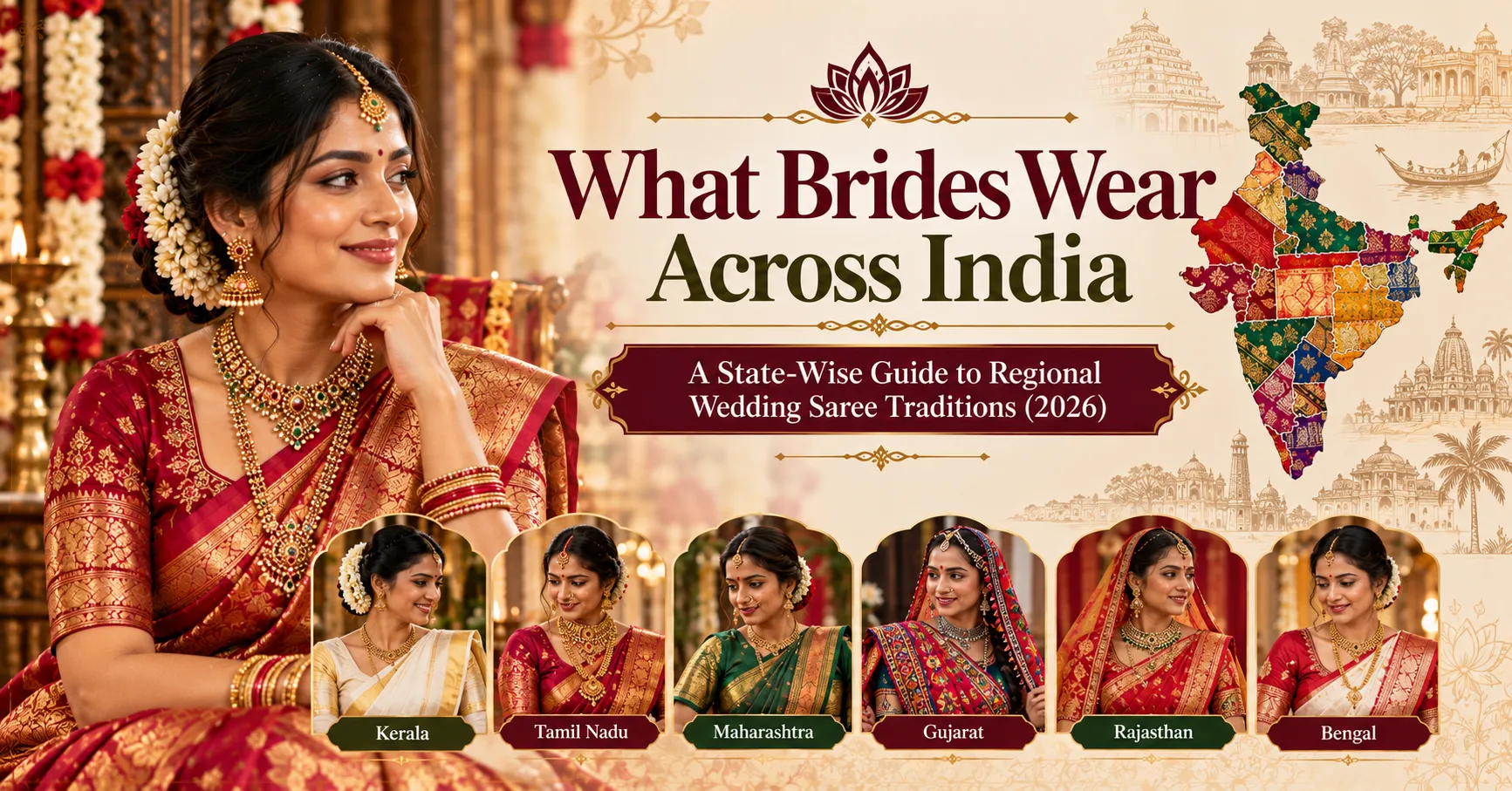
What Brides Wear Across India: A State-Wise Guide to Regional Wedding Saree Traditions (2026)
Ask someone to picture an Indian bride and they’ll probably imagine a red silk saree heavy with gold. That bride exists — but she is only one of many. A Gujarati bride may wear two sarees, one from each family. An Odia bride may wear yellow with a red border. A Malayali bride may glow in ivory and gold. An Assamese bride may not wear a saree at all, but a two-piece mekhela sador in golden Muga silk.
India doesn’t have one bridal saree. It has dozens, each shaped by a region’s weaving traditions, rituals and ideas of what is auspicious. This guide walks through the major traditions region by region, with a quick-reference table and tips for brides marrying into a culture that isn’t their own.
One important note before we begin: bridal customs vary not just by state but by community, religion, caste, and family. Treat this as a map of common traditions, and always ask the elders in your own family what they expect.
North India – Banarasi Silk, Bandhani & the Colour Red
Uttar Pradesh
Varanasi gave India its most famous bridal saree. A red or maroon Banarasi silk with dense gold zari brocade is the classic choice for brides across Uttar Pradesh and well beyond it. The real zari and Mughal-inspired motifs make it an heirloom from the day it’s bought. Our Banarasi buying guide and zari guide will help you choose one worth passing down.
Bihar
Banarasi and other silk sarees in red are widely worn for the main ceremony. In many Bihari and Bhojpuri-speaking families, the bride also wears a yellow saree, known as the piyari, during wedding rituals.
Rajasthan
Traditionally, Rajasthani brides wear a poshak — a lehenga, kurti, and odhni — rather than a saree, often with a red Bandhani odhni. Brides who choose a saree often pick a red Bandhani or a gota-patti silk that echoes the same tradition.
Punjab
Punjabi brides traditionally wear a lehenga or salwar suit, often with a phulkari-embroidered dupatta, rather than a saree. Sarees appear more at receptions and later family functions.
💡 Did you know? Red is so closely tied to marriage in North India that many families expect it for the main ceremony, even when the bride wears pastels for every other function.
West India – Paithani, Panetar, Gharchola & Patola
Maharashtra
The Maharashtrian bride’s signature is the Paithani, with its jewel-toned silk body and gold peacock pallu, often draped in the nine-yard nauvari style. For the Gaurihar puja before the wedding, the bride traditionally wears a Paithani or silk shalu, often gifted by her maternal uncle, and she receives green glass bangles in the chuda ceremony as a symbol of fertility and new life. Explore our top 10 handloom Paithani picks and the much-loved Aboli Paithani.
Gujarat
A traditional Gujarati bride may wear two sarees on her wedding day. The Panetar — white or cream with a red border, customarily gifted by her maternal uncle — is worn for the ceremony. The Gharchola — a red, maroon or green silk with a zari grid filled with Bandhani motifs — is traditionally gifted by the groom’s family. For families who can afford it, a double-ikat Patola is the ultimate heirloom.
💡 Did you know? The two Gujarati bridal sarees represent the two families: the Panetar from the bride’s side, the Gharchola from her new home.
South India – Kanchipuram, Kasavu & Temple-Bordered Silks
Tamil Nadu
Kanchipuram (Kanjivaram) silk, often in shades of red or maroon with broad zari temple borders, is the classic Tamil bridal saree. Many Tamil Brahmin brides drape the nine-yard madisar for the wedding rituals, while some communities traditionally wear red-and-white checked sarees.
Kerala
The Malayali bride is instantly recognisable in a Kasavu saree or set-mundu — ivory with a gold border — often paired with temple jewellery and jasmine. Many brides now choose a Kanchipuram silk for the ceremony and Kasavu for other rituals. Our South Indian cotton saree guide covers Kasavu in more detail.
Karnataka
Pure Mysore silk, smooth and lustrous with a zari border, is a favourite with Kannadiga brides, alongside Kanchipuram-style silks. In North Karnataka, the Ilkal saree is a cherished part of many brides’ trousseaux.
Andhra Pradesh & Telangana
Many Telugu brides traditionally wear an off-white or cream saree with a coloured border — often red — for the main muhurtham, then change into a rich silk for later rituals. Gadwal, Dharmavaram, Venkatagiri and Uppada silks are popular bridal weaves, and the double ikat of Pochampally is a beloved trousseau piece. See our handloom Ikat guide.
💡 Did you know? Ivory and gold, not red, is the bridal palette for many South Indian brides, especially in Kerala and Andhra Pradesh.
East India – Red Benarasi, Boula Patta & Mekhela Sador
West Bengal
The Bengali bride’s classic look is a red Benarasi (Banarasi) or Katan silk with gold zari, paired with the white shankha and red pola bangles, alta on her feet, and sandalwood designs on her forehead. Fine Jamdani and Dhakai sarees are also part of the tradition, usually in red.
Odisha
Odia brides are traditionally dressed in a yellow saree with a red border, known as Boula Patta, though red is also widely worn. The state’s wedding weaves include Sambalpuri ikat, Khandua from Cuttack, Bomkai and Sonepuri, and Berhampur Patta.
Assam
The Assamese bride traditionally wears a mekhela sador — a two-piece drape of a pleated skirt and a chest drape — rather than a conventional saree. Bridal sets are woven in golden Muga silk or ivory Pat silk, and the riha remains part of the bridal trousseau.
💡 Did you know? Muga silk, known as the golden silk of Assam, has a natural golden sheen that isn’t dyed in.
Central India – Chanderi & Maheshwari
Madhya Pradesh’s two great weaves are lighter than bridal silk, so many brides here wear a Banarasi or a lehenga for the main ceremony. Chanderi and Maheshwari come into their own for daytime rituals, post-wedding pujas and the bride’s mother and sisters. Their sheer drape and delicate zari are perfect for long summer ceremonies.
State-Wise Bridal Saree Quick Reference Table
| State / Region | Traditional Bridal Attire | Signature Detail | Traditional Colours |
| Uttar Pradesh | Banarasi silk saree | Heavy zari brocade | Red, maroon |
| Bihar | Banarasi or silk saree; yellow piyari in many families | Piyari worn for rituals | Red, yellow |
| Rajasthan | Poshak (lehenga & odhni); Bandhani saree | Red Bandhani odhni | Red, pink |
| Punjab | Lehenga or salwar suit | Phulkari dupatta | Red, pink |
| Maharashtra | Paithani or silk shalu, often nauvari | Gold peacock pallu | Jewel tones; green bangles |
| Gujarat | Panetar and Gharchola | One saree from each family | Red & white; red, green |
| West Bengal | Red Benarasi or Katan silk; Jamdani | Shankha-pola bangles, alta | Red |
| Odisha | Boula Patta; Sambalpuri, Khandua, Berhampur Patta | Yellow with red border | Yellow, red |
| Assam | Mekhela sador in Muga or Pat silk | Two-piece drape | Golden, ivory |
| Tamil Nadu | Kanchipuram silk; madisar in some communities | Broad zari temple borders | Red, maroon |
| Kerala | Kasavu saree or set-mundu; Kanchipuram | Ivory with gold border | Ivory & gold |
| Karnataka | Mysore silk; Ilkal in North Karnataka | Smooth silk, zari border | Jewel tones |
| Andhra & Telangana | Off-white saree with coloured border; Gadwal, Dharmavaram, Uppada | Change of saree between rituals | Cream with red; rich silks |
| Madhya Pradesh | Banarasi or lehenga; Chanderi & Maheshwari for rituals | Sheer drape, fine zari | Pastels, jewel tones |
Many of these weaves are protected by Geographical Indication tags — see our guide to GI-tagged sarees.
How Bridal Traditions Are Evolving in 2026
- Pastels alongside red. Many brides keep red for the main ceremony but choose blush, mint or champagne for the engagement and other functions. See our engagement and roka saree guide.
- A saree for every ritual. Multi-day weddings mean brides plan four or five drapes. Our wedding function saree guide maps one to each event.
- Heirloom re-wearing. More brides are wearing their mother’s or grandmother’s wedding saree, restyled with a new blouse.
- Two cultures, two drapes. In inter-regional weddings, brides often honour both families — a Paithani for one ceremony and a Kanchipuram for the other.
- Handloom over machine-made. Brides increasingly want verified handwoven silk. Our guide to identifying genuine handloom sarees shows what to check.
Marrying Into a Different Culture? 5 Tips
- Ask early. Find out which sarees are expected, for which rituals, and who traditionally gifts them.
- Learn the drape. Nauvari, madisar and the Bengali drape need practice; many brides book a professional draper. Our draping guide is a good starting point.
- Match the blouse to the region. Elbow-length sleeves and high backs suit South Indian silks; Bengali brides often wear a deeper back. Browse our 2026 blouse designs.
- Budget for real silk. Our handloom saree price guide sets realistic expectations for each weave.
- Plan for the future. A bridal saree is an heirloom. Store it properly using our handloom saree care guide.
Every Bride’s Heritage, One Handloom Collection
At Shashikala Sarees, we bring together handwoven bridal and wedding sarees from several of India’s great weaving traditions: Banarasi, Paithani, Jamdani, Ikat, Chanderi, Maheshwari and South Indian cotton. Every saree comes with complete transparency on fabric, zari and origin. For curated picks for the big day, see our best traditional sarees for weddings and festivals.
➤ Explore our bridal handloom collection at ShashikalaSarees.com
FAQ’s
Q1: Do all Indian brides wear red?
No. Red is the most common bridal colour, especially in North India and Bengal, but many brides wear other colours by tradition. Kerala brides often wear ivory and gold Kasavu, Odia brides traditionally wear a yellow saree with a red border (Boula Patta), and many Telugu brides wear an off-white saree with a coloured border for the main ceremony.
Q2: What does a Gujarati bride wear?
A traditional Gujarati bride may wear two sarees: the Panetar, a white or cream saree with a red border customarily gifted by her maternal uncle, and the Gharchola, a red, maroon or green silk with a zari grid and Bandhani motifs traditionally gifted by the groom’s family.
Q3: What does a Maharashtrian bride wear?
A Maharashtrian bride typically wears a Paithani silk saree, often draped in the nine-yard nauvari style. For the Gaurihar puja she traditionally wears a Paithani or silk shalu, often gifted by her maternal uncle, and green glass bangles are part of the bridal look.
Q4: What does a Bengali bride wear?
The classic Bengali bridal look is a red Benarasi or Katan silk saree with gold zari, white shankha and red pola bangles, alta on the feet and sandalwood designs on the forehead. Red Jamdani and Dhakai sarees are also traditional.
Q5: What do South Indian brides wear?
Tamil brides commonly wear Kanchipuram silk, sometimes in the nine-yard madisar drape. Kerala brides are known for ivory-and-gold Kasavu. Kannadiga brides often choose Mysore silk, and Telugu brides commonly wear an off-white saree with a coloured border for the muhurtham along with Gadwal, Dharmavaram or Uppada silks.

About author



Add comment