
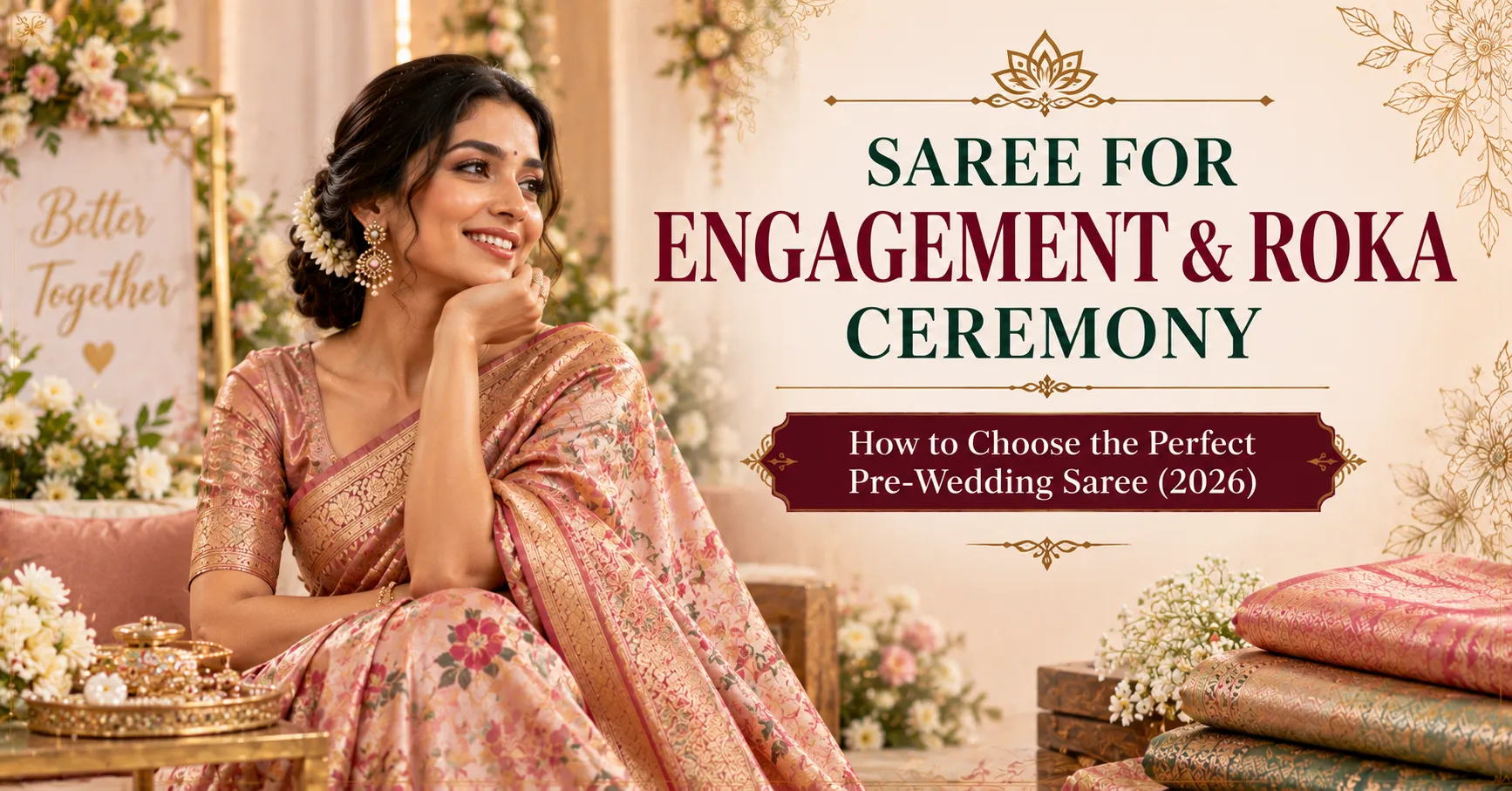
Saree for Engagement and Roka Ceremony – How to Choose the Perfect Pre-Wedding Saree (2026)
The engagement marks the beginning of a wedding story. It’s the first time both families gather together, the first time photographs will be taken as a couple, and — for many women — the first time they shop for a wedding-related saree.
But here’s where most women get it wrong: they either overdress (wearing a full bridal saree that steals the wedding’s thunder) or underdress (picking something too casual for an occasion this important). The engagement and roka sit in a specific zone: special but not bridal. Elegant but not over-the-top.
This guide helps brides-to-be, guests, and family members find the right saree for both roka and engagement ceremonies — with fabric, colour, budget, and styling advice tailored to the unique energy of pre-wedding celebrations.
Roka vs Engagement – How the Dress Code Differs
Many people use “roka” and “engagement” interchangeably, but they’re different events with different dress codes:
| Parameter | Roka | Engagement (Sagai) |
| What it is | First formal step; families agree to the match | Ring exchange ceremony; formal announcement |
| Scale | Intimate (15–50 guests), often at home | Larger (50–300+ guests), often at a venue |
| Dress code | Semi-formal, elegant-casual | Formal-festive, wedding-adjacent |
| Best saree weight | Lightweight silk or cotton-silk | Mid to heavy silk, designer saree |
| Jewellery level | Understated — studs, delicate necklace | Statement — kundan set, jhumkas, maang tikka |
The key rule for both: beautiful but not bridal. Save the heavy red silk and full bridal jewellery for the wedding day itself. The engagement should feel like a preview, not a spoiler.
Engagement Saree for the Bride-to-Be – Fabric, Colour & Styling
As the bride, all eyes are on you. Your saree should look special, photograph beautifully, and feel comfortable through hours of greeting, rituals, and ring-exchange moments.
Best colours for the bride:
- Pastels: Blush pink, powder blue, mint green, lavender, and champagne are the most popular engagement colours in 2026. They photograph beautifully, look fresh in daylight, and feel distinctly “engagement” without entering bridal territory.
- Soft jewel tones: Dusty rose, sage green, mauve, and soft teal offer a slightly richer alternative for evening engagements.
- Avoid: Bridal red (save it for the wedding), pure white (can read bridal or mourning depending on culture), and all-black (too sombre for a celebration).
Best fabrics for the bride:
- For roka (intimate): A lightweight Chanderi silk-cotton in a pastel shade is the perfect roka saree — elegant, lightweight, and appropriate for a home or small-venue setting. Explore our Chanderi colour guide for the right shade.
- For engagement (formal): A Tussar silk in champagne or soft gold, or a Maheshwari silk in dusty rose or mauve, offers the right level of formality without heaviness. For winter engagements, a lighter-weight Banarasi in pastel pink or mint with subtle zari is stunning.
💡 Bride’s tip: Your engagement saree is often your first “wedding shopping” purchase. Use it to set the tone. If you’re going traditional for the wedding, go contemporary for the engagement — and vice versa. The contrast between your engagement and wedding looks will make both feel special.
Engagement Saree for Guests & Family – What’s Appropriate
As a guest or family member, your job is to complement the bride, not compete with her. Dress festively but let the couple be the visual centre of the event.
Best colours for guests:
- Jewel tones: Emerald, sapphire, garnet, plum, and amethyst. These are celebratory, photograph well, and are appropriate for any engagement formality level.
- Warm metallics: Champagne gold, rose gold, antique bronze. Subtle shimmer without overpowering the couple.
- Avoid: Red (the bride’s colour at the wedding — wearing it at the engagement feels presumptive), pastels lighter than the bride’s (you shouldn’t look more “bridal” than her), and all-white/all-black.
Best fabrics for guests:
- Daytime engagement: Chanderi silk, Mangalagiri cotton (for casual rokas), or Ikat cotton-silk for a contemporary handloom look.
- Evening engagement: Maheshwari silk, Tussar silk, or georgette with sequin work for a glamorous finish.
- Mother of the bride/groom: A rich Banarasi silk or Paithani in a dignified jewel tone (navy, emerald, maroon) is the most appropriate choice. The saree should convey warmth and stature without competing with the bride.
Best Handloom Sarees for Engagement by Budget
| Budget | Best Saree Types | Best For | Pro Tip |
| Under ₹3,000 | Mangalagiri cotton, Chanderi cotton-silk, Ikat cotton | Intimate roka, casual daytime engagement, guests | Elevate with a contrast blouse and statement earrings |
| ₹3,000–₹7,000 | Chanderi silk, Tussar silk, Maheshwari silk, Jamdani | Bride’s roka, evening engagement, close family | Sweet spot for elegance without overspending pre-wedding |
| ₹7,000–₹15,000 | Lightweight Banarasi, Paithani, designer silk | Bride’s formal engagement, mother of bride/groom | Choose lighter zari weight than your wedding saree |
| Above ₹15,000 | Premium Banarasi in pastel, Kanchipuram silk | Grand engagement, multi-day celebration | This becomes a wardrobe staple for future events |
For complete pricing guidance across all handloom types, see our handloom saree price guide. If you’re gifting a saree for the engagement, our saree gift guide helps you choose by occasion and recipient.
Engagement Saree Styling – Jewellery, Blouse & Modern Draping
Blouse:
- A contemporary blouse elevates even a simple saree into an engagement-worthy look. Think boat necks, off-shoulders, cape sleeves, or embroidered backs. Browse our 2026 blouse design guide for trending cuts.
- For pastel sarees, a contrast blouse in a deeper tone (blush saree + wine blouse, mint saree + emerald blouse) adds visual interest and photographs beautifully.
Jewellery:
- Kundan or polki sets are the classic engagement jewellery choice — festive without being full-bridal.
- For roka, keep it lighter: pearl studs, a delicate pendant, and a few bangles.
- Avoid your full wedding jewellery set — it makes the engagement feel overdone and leaves nothing new for the wedding.
Draping:
- A classic Nivi drape with neatly fanned pallu pleats is the safest choice for engagement photographs. For a modern twist, try a front-pallu or belted drape. See our complete draping guide for step-by-step instructions.
- Pre-draped sarees are an excellent option for brides who aren’t confident with traditional draping — they look polished and stay in place through a long event.
💡 Photo tip: Engagement photos are second only to wedding photos in emotional value. Choose colours that complement your skin tone in natural light (not just tube light at the shop). Pastels and soft metallics photograph most flatteringly in daylight venues.
Start Your Wedding Journey at Shashikala Sarees
Your engagement is the opening chapter of your wedding story. At Shashikala Sarees, we offer handloom sarees for every pre-wedding moment — from delicate pastel Chanderi silks for intimate rokas, to elegant Tussar and Maheshwari silks for formal engagements, to rich Banarasi and Paithani for the mother of the bride. Every saree is handwoven, artisan-made, and comes with complete transparency.
For the wedding functions that follow, explore our wedding function saree guide covering haldi, mehndi, sangeet, and reception. And check our best traditional sarees for weddings and festivals for the main ceremony picks.
Start your wedding story in authentic handloom. 💍
Explore our engagement-ready handloom collection at ShashikalaSarees.com
FAQ’s
Q1: What colour saree should a bride wear for her engagement?
Pastels are the most popular choice for brides in 2026 — blush pink, powder blue, mint green, lavender, and champagne. These colours photograph beautifully, feel distinctly ‘engagement’ rather than bridal, and create a lovely contrast with your wedding saree. Avoid bridal red (save it for the wedding), pure white, and all-black.
Q2: What is the difference between a roka and an engagement?
A roka is the first formal step where both families agree to the match, typically an intimate gathering of 15–50 people. The engagement (sagai) is a larger, more formal event with a ring exchange and may have 50–300+ guests. The roka dress code is semi-formal and elegant-casual, while the engagement is formal-festive.
Q3: Can I wear a heavy silk saree for the engagement?
A lighter-weight silk (Chanderi, Tussar, Maheshwari) is generally more appropriate than a heavy Banarasi or Kanchipuram for most engagements. The goal is ‘special but not bridal.’ If you do choose a Banarasi, opt for a pastel shade with subtle zari rather than a full bridal red with heavy gold zari.
Q4: What should guests avoid wearing to an engagement?
Avoid red (the bride’s traditional wedding colour), pastels lighter than what the bride is wearing (you shouldn’t look more bridal than her), all-white, and all-black. Jewel tones like emerald, sapphire, and garnet are the safest and most celebratory choices for guests.
Q5: What saree should the mother of the bride/groom wear?
A rich silk saree in a dignified jewel tone (navy, emerald, maroon, wine) is the most appropriate choice. Banarasi silk and Paithani silk are popular options for mothers. The saree should convey warmth and stature without competing with the bride. Pair with traditional gold jewellery and a classic Nivi drape.


About author



Add comment