
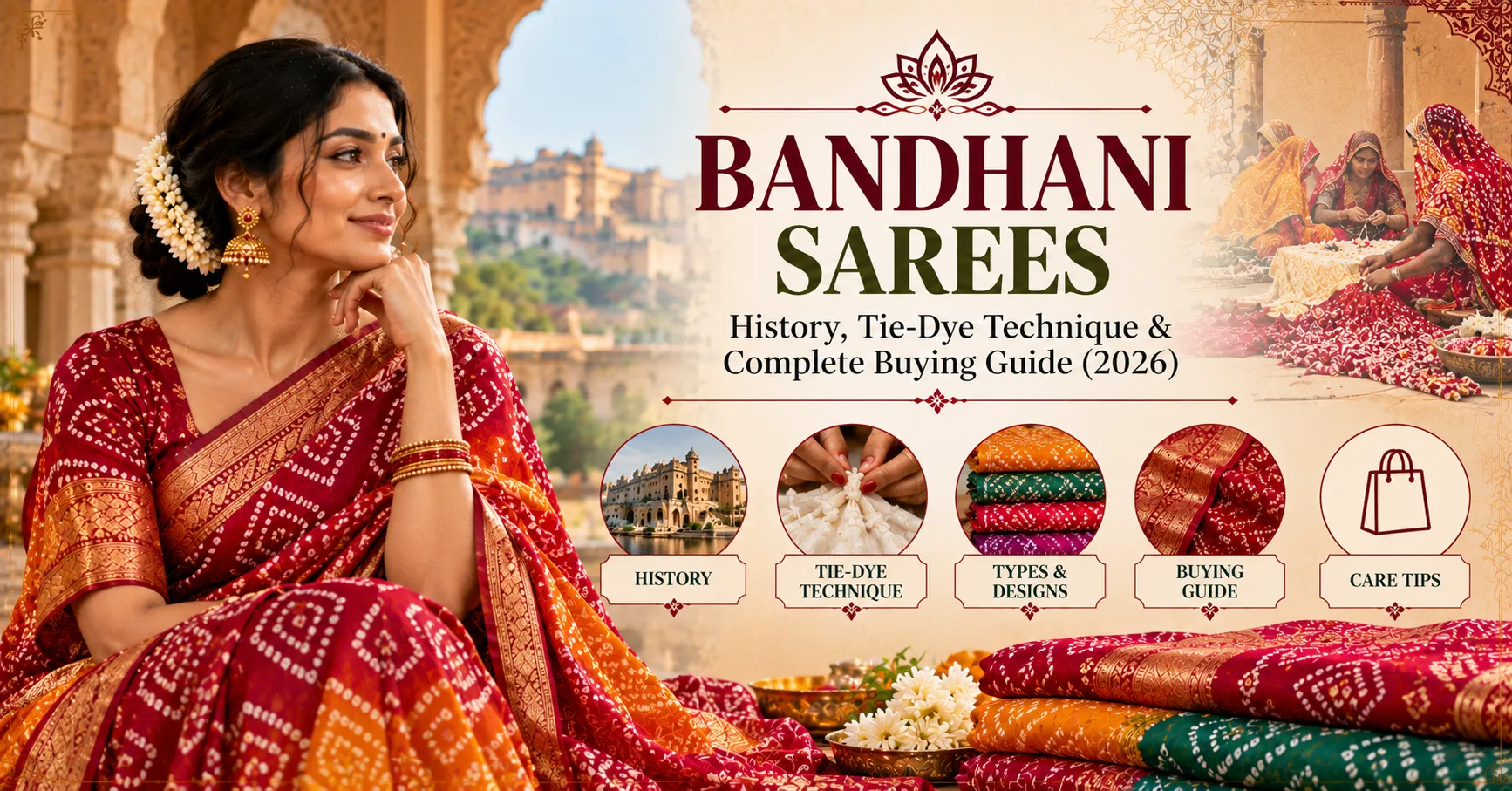
Bandhani Sarees: History, Tie-Dye Technique and Complete Buying Guide (2026)
QUICK FACTS
- Also called: Bandhej, Chunri, Chunari (Sungudi in Tamil Nadu)
- Origin: Rajasthan and Gujarat; one of the oldest tie-dye traditions in the world
- Key centres: Jaipur, Jodhpur, Udaipur, Sikar, Bikaner (Rajasthan); Kutch, Bhuj, Jamnagar, Mandvi (Gujarat)
- Technique: Tiny sections of fabric are pinched, tied with thread, and dyed; tied areas resist the dye
- Knots per saree: Anywhere from about 12,000 to over 1,00,000, each tied by hand
- Price range: ₹1,000 (cotton) to ₹40,000+ (fine silk Gharchola or Shikari work)
Few textiles say “celebration” quite like a Bandhani saree. The scattered dots, the jewel-bright colours, the slightly crinkled texture that tells you every pattern was tied by hand — Bandhani is the saree of Navratri nights, Rajasthani weddings, Gujarati bridal rituals, and festive mornings across western India.
It is also one of the oldest living textile crafts on the planet. The word comes from the Sanskrit bandh, meaning “to tie,” and the technique is commonly traced back around 5,000 years. Early literary references even describe Bandhani being worn at a royal wedding.
Yet today, most “Bandhani” sold online is a digital print imitating the dots. This guide explains how real Bandhani is made, the difference between Rajasthani and Gujarati styles, the named patterns, how to spot the genuine article, and what you should expect to pay.
What Is Bandhani? The Tie-Dye Technique Explained
Bandhani is a resist-dye craft. Instead of printing colour onto fabric, artisans prevent colour from reaching certain spots. The process unfolds in five stages:
- Marking: The design is stamped onto the fabric using a washable dye and wooden blocks, creating a map of where each knot will go.
- Tying: Artisans (traditionally women, using a long fingernail or a small metal ring) pinch tiny points of fabric and wind thread tightly around each one. This is the slowest stage — a single saree can take weeks.
- Dyeing: The tied fabric is dipped in dye, starting with the lightest colour. For multi-colour designs, more sections are tied and the fabric is re-dyed in progressively darker shades.
- Drying: The fabric is dried in open air, usually with the knots still tied.
- Opening: The knots are pulled open to reveal the undyed dots. Many traditional pieces are sold with the knots still intact, so the buyer pulls them open at home — a lovely ritual and a sign of authenticity.
Bandhani is related to ikat (where threads are resist-dyed before weaving) and to Ajrakh (where resist pastes are block-printed). The difference is that Bandhani resists dye on the finished fabric, knot by knot.
Rajasthani Bandhani vs Gujarati Bandhani – Key Differences
Both states share the craft, but their styles have evolved differently:
| Parameter | Rajasthani Bandhani | Gujarati Bandhani |
| Main centres | Jaipur, Jodhpur, Udaipur, Sikar, Bikaner | Kutch, Bhuj, Jamnagar, Mandvi |
| Signature styles | Leheriya (waves), Mothra (diamond grid), bold Chunri | Gharchola, Panetar, Shikari, Pancharangi |
| Dot size | Often bolder, larger dots | Often finer, denser dots |
| Colour mood | Bright, high-contrast (pink, yellow, orange, green) | Deep red, maroon, black with white/yellow dots |
| Extra embellishment | Gota patti borders are popular | Mirror work and zari grids (in Gharchola) |
| Best known for | Festive and monsoon wear (Teej, Gangaur) | Bridal and ceremonial wear |
Tamil Nadu has its own related tradition, Sungudi from Madurai, which uses a similar tie-dot technique on cotton.
Types of Bandhani Patterns – What Each Name Means
Every Bandhani pattern has a name, and knowing them helps you read a saree like an expert:
| Pattern | What It Looks Like | Best For |
| Ekdali | Single dots scattered or in rows — the simplest pattern | Everyday and office-friendly Bandhani |
| Trikunti | Three dots grouped in a triangle | Base pattern for florals and borders |
| Chaubandi | Four dots grouped in a square | Festive sarees, dupattas |
| Boond | Tiny dot with a dark coloured centre | Fine, premium pieces |
| Kodi | Teardrop-shaped dot clusters | Borders and pallus |
| Dungar Shahi | Mountain-like triangular formations | Bold statement sarees |
| Jaaldar | Net-like all-over web of fine dots | Elegant evening wear |
| Laddu Jalebi | Swirling, spiral dot clusters | Playful festive looks |
| Shikari | Figurative motifs — animals, dancers, hunting scenes | Collector pieces; the most complex Bandhani |
| Leheriya | Diagonal wave stripes (a related Rajasthani tie technique) | Monsoon festivals, Teej, haldi |
| Mothra | Criss-cross diamond grid | Contemporary, geometric looks |
Bridal & Ceremonial Bandhani – Gharchola, Panetar & Chunri
In Gujarat and Rajasthan, Bandhani is not just festive — it is ritually significant for married women:
- Gharchola: A Gujarati bridal saree with a grid of zari (gold thread) squares, each filled with Bandhani motifs such as elephants, dancers or flowers. Traditionally gifted to the bride by her in-laws, usually in red, maroon or green.
- Panetar: A white or cream saree with a red Bandhani border and pallu, traditionally gifted by the bride’s maternal uncle and worn during the wedding ceremony.
- Rajasthani Chunri: Red or pink dotted Bandhani worn by brides and married women; a common choice for Karwa Chauth, Teej and Gangaur in Rajasthan.
- Pancharangi: A five-colour Bandhani associated with Jamnagar, popular for festive occasions.
If you’re planning a full wedding wardrobe, see our wedding function saree guide and our edit of the best traditional sarees for weddings and festivals.
Bandhani Cotton vs Silk vs Georgette – Which to Choose?
- Cotton Bandhani: Lightweight, breathable and affordable. Ideal for summer, daily wear and long garba nights. The dots tend to be slightly softer-edged.
- Silk Bandhani (including Gaji silk): Rich lustre that makes the colours glow. The natural choice for weddings, Gharchola and formal festivities.
- Georgette & chiffon Bandhani: Fluid, easy to drape and popular for parties. Usually mid-priced.
- Art silk / crepe: Budget-friendly options that hold dye well, though they lack the depth of pure silk.
For a broader look at how fabric choice changes with the weather, read our seasonal saree fabric guide.
How to Identify Authentic Bandhani (Hand-Tied vs Printed)
A huge share of online “Bandhani” is digitally printed. Here’s how to tell the difference:
- Feel for texture: Hand-tied Bandhani has a slightly puckered, crinkled feel where each knot was. Printed fabric is completely flat.
- Look closely at the dots: Real dots are slightly irregular, with soft, feathered edges where dye crept in. Printed dots are perfect circles with sharp edges and identical spacing.
- Check the reverse: Because the fabric is dyed through, the pattern is equally visible on both sides. A printed saree looks paler or blank on the back.
- Knots still tied? Pieces sold with some knots intact are almost always genuine — nobody ties knots on a print.
- Price reality check: A full six-yard saree with thousands of hand-tied knots cannot be produced for ₹500. Very cheap “Bandhani” is almost certainly printed.
One important nuance: Bandhani is a hand-dyeing craft, so the base fabric may be mill-woven or handwoven. Authenticity is about the tie-dye, not necessarily the loom. To understand the loom side of the story, read our handloom vs machine-made saree guide and our checklist for identifying genuine handloom sarees. Kutch Bandhani is also protected as a GI-tagged craft.
Bandhani Saree Price Range in 2026
| Type | Approx. Price | What Drives the Price |
| Printed “Bandhani” | ₹400–₹1,200 | Not tie-dyed; decorative imitation only |
| Hand-tied cotton | ₹1,000–₹3,000 | Dot density, number of colours |
| Hand-tied georgette / art silk | ₹2,000–₹6,000 | Fabric quality, gota or mirror borders |
| Hand-tied pure silk (Gaji, etc.) | ₹5,000–₹20,000 | Silk quality, fineness of dots, colour layers |
| Gharchola / fine Shikari | ₹10,000–₹40,000+ | Zari grid, figurative tying, months of labour |
Prices vary by seller and region; compare with our handloom saree price guide for benchmarks across other crafts.
How to Style Bandhani for Different Occasions
- Navratri & garba: Bandhani is the quintessential garba saree. Pair cotton Bandhani with a mirror-work blouse and oxidised jewellery, and use our Navratri 2026 colour guide to match each night’s colour.
- Karwa Chauth & Teej: A red or pink silk Chunri with kundan jewellery is the classic Rajasthani look. See our Karwa Chauth saree guide for full styling.
- Weddings: Silk Gharchola or Panetar for the ceremony; Leheriya or bright Bandhani for haldi and mehndi.
- Everyday & office: Choose fine Ekdali dots in muted tones (indigo, mustard, rust) with a solid cotton blouse.
- Blouse & drape: Bandhani is busy, so keep the blouse solid or lightly embellished. Explore our 2026 blouse designs and try the Gujarati seedha pallu drape from our draping guide.
Caring for Your Bandhani Saree
- Dry clean the first wash. Natural and traditional dyes can bleed, especially deep reds.
- If hand-washing later, use cold water and mild detergent, wash separately, and never wring.
- Dry in shade — direct sun fades Bandhani colours quickly.
- Steam rather than press flat if you want to keep the crinkled texture.
- Store wrapped in muslin and refold every few months. Our handloom saree care guide covers long-term storage in detail.
Explore India’s Resist-Dye & Handloom Traditions at Shashikala
Bandhani belongs to a wider family of western Indian resist-dye crafts. If you love its earthy, hand-made character, you’ll also love authentic Ajrakh sarees from the same desert belt, the thread-dyed geometry of handloom Ikat, and festive handwoven silks like Banarasi and Paithani. Every Shashikala saree comes with full transparency on technique, fabric, and origin.
Explore our handcrafted saree collection at ShashikalaSarees.com
FAQ’s
Q1: What is a Bandhani saree?
A Bandhani (or Bandhej) saree is made using a traditional tie-dye technique from Rajasthan and Gujarat. Tiny points of fabric are pinched and tied with thread before dyeing; the tied areas resist the dye and form dot patterns once the knots are opened. A single saree can have tens of thousands of hand-tied knots.
Q2: What is the difference between Bandhani and Leheriya?
Bandhani creates dot-based patterns by tying small points of fabric. Leheriya, a Rajasthani technique, rolls and ties the fabric diagonally to create wave-like stripes. Both are resist-dye crafts from the same region and are often sold together, but the patterns and tying methods differ.
Q3: How can I tell if a Bandhani saree is hand-tied or printed?
Hand-tied Bandhani has a crinkled texture, slightly irregular dots with soft edges, and the pattern shows clearly on both sides. Printed versions are flat, with perfectly round, sharp-edged dots that are paler or absent on the reverse. Sarees sold with some knots still tied are almost always genuine.
Q4: What is a Gharchola saree?
Gharchola is a traditional Gujarati bridal saree featuring a grid of zari squares, each filled with Bandhani motifs such as elephants, flowers or dancers. It is traditionally gifted to the bride by her in-laws and is usually red, maroon or green.
Q5: Is Bandhani suitable for summer?
Yes — cotton Bandhani is one of the best summer sarees because it is light and breathable. Silk Bandhani is better suited to evening events, weddings and

About author



Add comment