
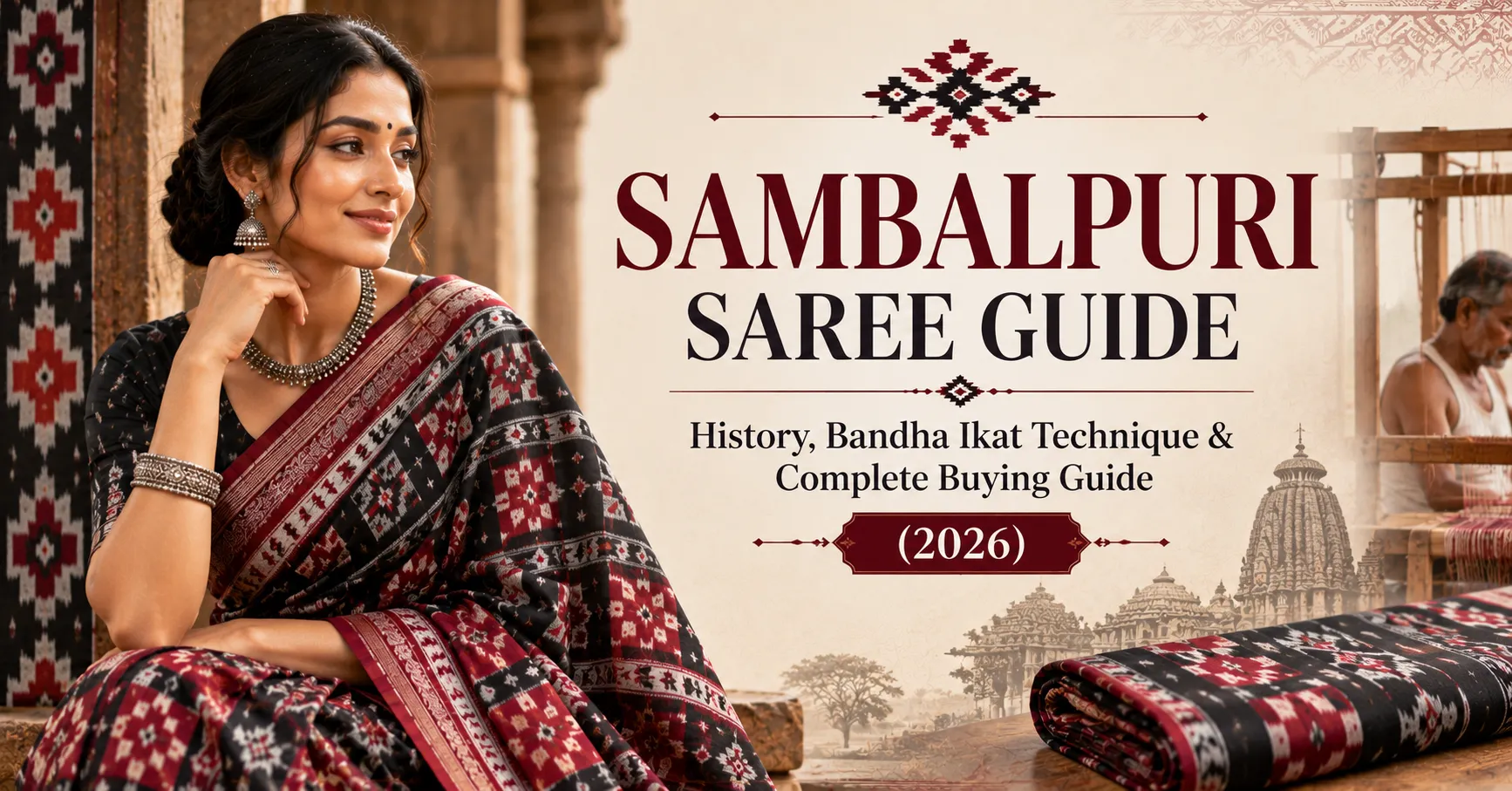
Sambalpuri Saree Guide: History, Bandha Ikat Technique & Complete Buying Guide (2026)
QUICK FACTS
- Origin: Western Odisha (Sambalpur, Bargarh, Sonepur, Boudh, Balangir districts)
- Technique: Bandha (tie-dye) ikat — both single and double ikat variations
- Weaving communities: Bhulia and Meher families
- GI Status: Registered as ‘Odisha Ikat’ under GI Act 1999
- Signature motifs: Shankha (conch), Chakra (wheel), Phula (flower)
- History: Dates back to approximately 600 BC
- Fabrics: Cotton, silk, Tussar silk, Bapta (cotton-silk blend)
- Price range: ₹1,500 (cotton) to ₹15,000+ (premium silk)
When Indira Gandhi wore a Sambalpuri saree in the 1980s, she introduced the world to what Odisha had treasured for over 2,500 years — one of India’s oldest and most sophisticated textile traditions. Yet despite its ancient heritage and GI certification, the Sambalpuri saree remains remarkably underrated outside eastern India.
That’s a shame, because the Sambalpuri is extraordinary. The bandha (tie-dye ikat) technique used to create these sarees involves dyeing intricate patterns into individual threads before they are placed on the loom. The design exists in bundles of yarn before a single thread is woven. The result is a saree where the motifs seem to emerge from within the fabric itself — not printed on top of it.
This guide covers the bandha technique, the different types of Sambalpuri sarees, how to verify authenticity, realistic pricing, and how to style these beautiful textiles for different occasions.
What Is Sambalpuri? The Bandha (Tie-Dye) Technique Explained
The word bandha means “to tie” in Odia. The bandha technique (known globally as ‘ikat’) involves tying small sections of warp and/or weft threads with wax-coated cotton thread to create a resist pattern, then immersing the tied bundles in dye baths. The tied sections resist the dye, creating patterns in the undyed areas.
Key technical details:
- Single ikat: Either the warp or weft threads are resist-dyed. This is the most common form and is used in everyday Sambalpuri sarees.
- Double ikat: Both warp and weft threads are independently resist-dyed and then aligned during weaving. This is the rarest and most labour-intensive form, requiring extraordinary precision. Each intersection must align perfectly to create the final pattern.
- Pit looms: Sambalpuri weavers use traditional pit looms with a throw/fly shuttle technique. The weaver sits with legs in a pit below the loom, using hand and foot pedals to control warp tension.
If you’re familiar with Pochampally Ikat from Telangana, the Sambalpuri bandha uses the same foundational technique but with distinctly different motifs, colour palettes, and cultural symbolism. Our cotton vs silk Ikat guide covers the broader ikat family in detail.
Types of Sambalpuri Sarees
The Sambalpuri tradition encompasses several distinct sub-types, each with its own character:
| Type | Region | Key Feature | Best For | Price Range |
| Pasapalli | Bargarh / Sonepur | Chessboard pattern in bold contrasting colours | Festive wear, formal events | ₹3,000–₹12,000 |
| Sonepuri | Sonepur | Fine silk with elegant sheen and refined motifs | Weddings, silk collectors | ₹5,000–₹15,000+ |
| Bomkai | Ganjam / Sonepur | Mix of tribal and classical art with supplementary weft embroidery | Festive, cultural events | ₹3,000–₹10,000 |
| Barpali | Barpali | Simpler designs, everyday elegance | Daily wear, office | ₹1,500–₹4,000 |
| Bapta | Various | Cotton-silk blend, best of both textures | Transitional dressing, travel | ₹2,000–₹6,000 |
| Sachipar | Various | Two-coloured body divided into panels | Contemporary styling, parties | ₹2,500–₹8,000 |
Each type has its own aesthetic — but all share the fundamental bandha ikat technique and the signature shankha-chakra (conch-wheel) motifs that are uniquely Odisha’s. For broader pricing benchmarks across all handloom types, check our handloom saree price guide.
Shankha-Chakra: The Motifs That Define Sambalpuri Identity
Sambalpuri motifs are not just decorative — they carry deep cultural and spiritual meaning:
- Shankha (Conch): Represents Lord Vishnu and is considered sacred in Odisha’s Jagannath tradition. The conch is the most iconic Sambalpuri motif and appears on borders, pallus, and body patterns.
- Chakra (Wheel): Symbolises the Sudarshana Chakra of Lord Vishnu and the wheel of the Konark Sun Temple. Often paired with the shankha to create the famous “shankha-chakra” pattern.
- Phula (Flower): Floral motifs representing nature and fertility. Common varieties include padma (lotus) and full-bloom flowers.
- Temple borders: Inspired by the gopuram architecture of Odisha’s ancient temples, similar to South Indian temple borders but with a distinctly eastern Indian geometry.
- Tribal & nature motifs: Deer, elephants, fish, and abstract tribal patterns drawn from Odisha’s Adivasi art traditions.
This spiritual depth is what sets Sambalpuri apart from purely decorative textiles. Each saree tells a story rooted in Odisha’s temple culture and natural world. Learn more about how India protects these heritage designs through our GI-tagged sarees of India guide.
How to Identify an Authentic Sambalpuri Saree
With printed imitations flooding online marketplaces, knowing how to verify a genuine Sambalpuri is essential:
- Check the reverse: In genuine bandha ikat, the pattern is visible on both sides of the fabric (not just the front). Printed copies have a flat, featureless reverse.
- Look for ikat ‘bleeding’: Authentic ikat has a soft, feathered edge where one colour transitions to another — this is the natural result of resist-dyeing. Printed copies have sharp, clean colour boundaries.
- Examine the selvedge: Handloom Sambalpuri has slightly uneven, natural selvedge with visible thread loops. Machine-made copies have perfectly uniform, clean-cut edges.
- Ask for the GI tag and Handloom Mark: Authentic Sambalpuri from registered weavers carries the Odisha Ikat GI tag and/or the Government of India Handloom Mark. Our guide on identifying genuine handloom sarees covers the complete authenticity checklist.
- Buy from trusted sources: Boyanika (Odisha State Handloom Cooperative) is the most reliable official source. Reputed handloom brands with transparent sourcing are equally trustworthy. Be sceptical of “Sambalpuri” sarees priced below ₹1,000 — genuine handloom cannot be produced at that cost. Our handloom vs machine-made guide explains why.
Sambalpuri vs Pochampally Ikat – Key Differences
| Parameter | Sambalpuri (Odisha) | Pochampally (Telangana) |
| Technique | Bandha ikat (single & double) | Ikat (primarily single) |
| Signature motifs | Shankha (conch), Chakra (wheel), temple borders | Geometric diamonds, arrows, zigzag |
| Cultural roots | Jagannath temple tradition, tribal art | Nizam-era, Deccan plateau craft |
| Colour palette | Red-black-white, maroon-gold, deep contrasts | Brighter, more varied colour combinations |
| Fabrics | Cotton, silk, Tussar, Bapta blend | Cotton, silk |
| Weaving loom | Pit loom with fly shuttle | Frame loom |
| GI tag | Odisha Ikat (2007) | Pochampally Ikat (2005) |
Both are beautiful, GI-tagged ikat traditions. Sambalpuri carries a more spiritual, temple-art aesthetic, while Pochampally is bolder and more geometric. Both are excellent additions to any handloom wardrobe.
How to Style Sambalpuri for Different Occasions
- Daily wear: Barpali cotton and Bapta blend sarees are perfect for everyday elegance. Lightweight, durable, and comfortable in Odisha’s humid climate. See our best handloom sarees for office wear for more work-friendly handloom picks.
- Festive occasions: Pasapalli silk in red-black or maroon-gold is the go-to for Durga Puja, Raja festival, and Nuakhai. The bold chessboard pattern makes a striking festive statement.
- Weddings: Sonepuri silk with dense shankha-chakra motifs and gold borders is the premium wedding choice. In Odisha, a Sambalpuri pata saree is considered the most auspicious bridal textile.
- Contemporary styling: Sachipar (two-toned) and Bichitrapuri varieties work beautifully with modern draping styles and fusion outfits. Pair with a contrast blouse and minimal jewellery for an art-gallery or brunch look.
For draping techniques that complement Sambalpuri’s structured texture, see our complete draping guide. And to keep your Sambalpuri looking fresh for years, follow our handloom saree care and storage tips.
Explore Odisha’s Heritage at Shashikala Sarees
At Shashikala Sarees, we celebrate the ikat tradition across India’s finest weaving clusters. Our collection includes handwoven Ikat sarees alongside heritage handlooms from every major weaving tradition — Banarasi, Paithani, Chanderi, Maheshwari, Ajrakh, and more. Every saree is sourced directly from artisan communities with complete transparency on fabric, technique, and origin.
Odisha’s weavers have been telling stories in thread for over 2,500 years. When you wear a Sambalpuri, you wear one of those stories.
➤ Explore our heritage handloom collection at ShashikalaSarees.com
FAQ’s
Q1: What is a Sambalpuri saree?
A Sambalpuri saree is a traditional handwoven textile from western Odisha, made using the bandha (tie-dye ikat) technique. Warp and/or weft threads are resist-dyed to create patterns before being woven on a pit loom. The sarees are known for their shankha (conch) and chakra (wheel) motifs drawn from Odisha’s Jagannath temple tradition. They are available in cotton, silk, Tussar silk, and Bapta (cotton-silk blend).
Q2: What are the different types of Sambalpuri sarees?
The main types include Pasapalli (chessboard pattern), Sonepuri (fine silk with elegant motifs), Bomkai (tribal and classical art with supplementary weft), Barpali (simpler daily-wear designs), Bapta (cotton-silk blend), and Sachipar (two-coloured body panels). Each has its own aesthetic, price range, and best-suited occasions.
Q3: How can I tell if a Sambalpuri saree is genuine?
Check the reverse side — genuine ikat shows the pattern on both sides. Look for the characteristic feathered colour transitions (not sharp lines). Examine the selvedge for natural irregularities. Ask for the Odisha Ikat GI tag or Handloom Mark. Be sceptical of ‘Sambalpuri’ sarees priced below ₹1,000 — genuine handloom cannot be produced at that cost.
Q4: What is the difference between Sambalpuri and Pochampally Ikat?
Both use the ikat resist-dyeing technique, but they come from different states and traditions. Sambalpuri (Odisha) features shankha-chakra motifs inspired by temple art, uses pit looms, and comes in cotton, silk, and Bapta blends. Pochampally (Telangana) features bolder geometric designs, uses frame looms, and is available in cotton and silk. Both are GI-tagged.
Q5: What is the price range for Sambalpuri sarees?
Cotton Sambalpuri sarees start from approximately ₹1,500 for simple Barpali designs. Mid-range Pasapalli and Bomkai silk sarees cost ₹3,000–₹10,000. Premium Sonepuri silk with intricate bandha work and heavy borders ranges from ₹8,000 to ₹15,000 or more. The price depends on fabric type (cotton vs silk), complexity of the ikat pattern, and density of the weave.


About author



One comment
Pingback:
What Brides Wear Across India: A State-Wise Guide to Regional Wedding Saree Traditions (2026) - Shashikala Sarees