
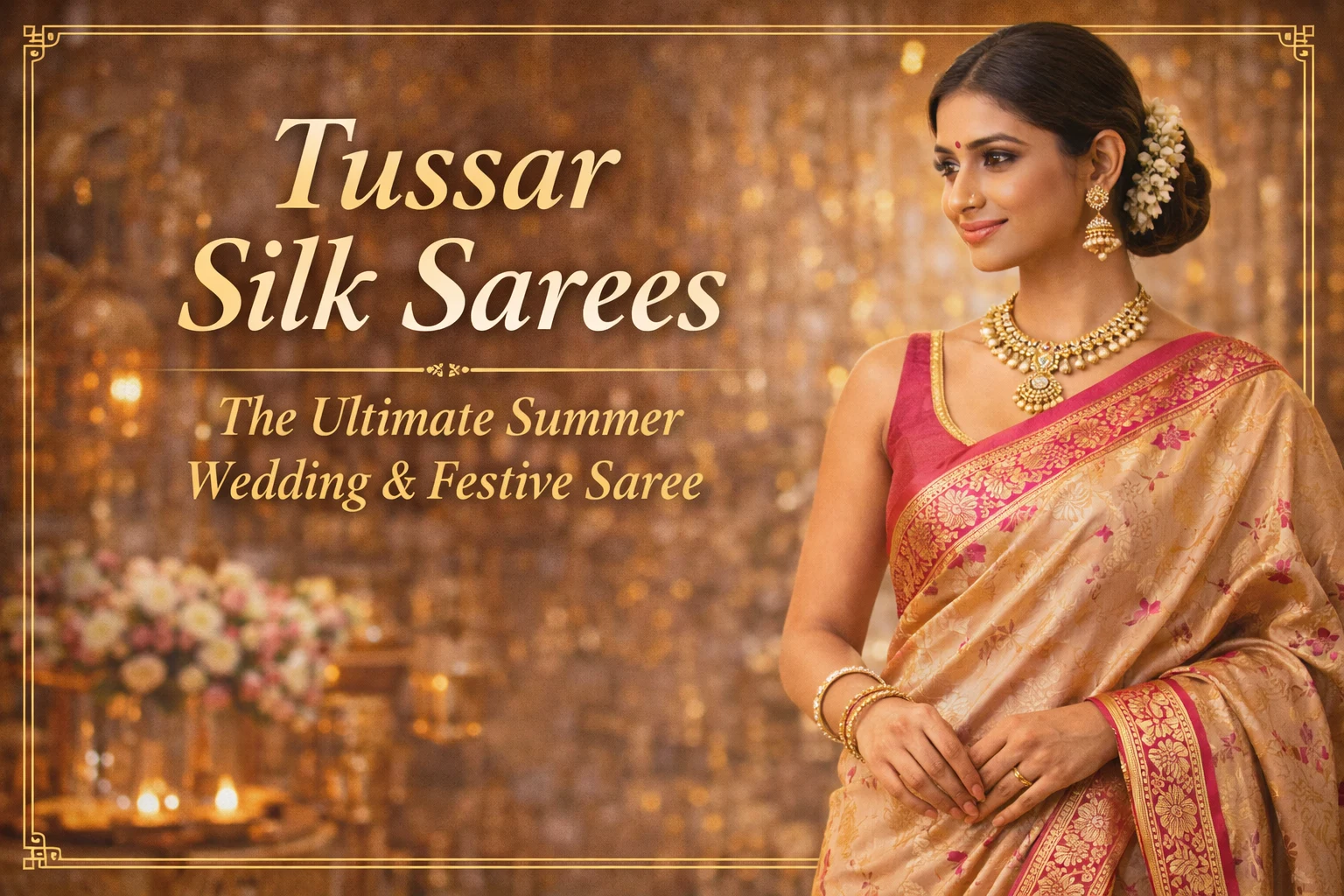
Tussar Silk Sarees: The Ultimate Summer Wedding & Festive Saree
There is something genuinely special about a fabric that has been woven in tribal heartlands for over a thousand years — and still turns heads at every wedding mandap in 2026. Tussar silk sarees, also known as Tasar silk sarees, are having a well-deserved moment among modern Indian women who want elegance without compromise.
Unlike heavily embellished options, a Tussar silk saree brings a quiet, earthy grandeur that is difficult to replicate. Its natural golden texture, breathable weave, and artisan story make it the go-to drape for summer weddings and festive occasions alike.
If you have been considering a tussar silk saree online purchase but are unsure where to start, this guide covers everything — from fabric origins to styling tips and honest price expectations.
| Quick Fabric Facts: Tussar Silk at a Glance
• Also known as: Tasar silk, Bhagalpuri silk, wild silk saree, Kosa silk • Origin: Jharkhand, Bihar & Chhattisgarh, India • Source: Wild silkworms (Antheraea species) — not farmed • Texture: Naturally coarse, matte-golden sheen • Best for: Summer weddings, festive wear, day functions • GI Tag: Bhagalpuri Silk holds Geographical Indication status • Care: Dry clean or gentle hand wash in cold water |
What Is Tussar Silk? Origin, Fabric & Weaving Process
Tussar silk — often spelled Tasar silk — is a wild silk variety produced by silkworms that feed on Arjun, Asan, and Sal trees in the forests of Jharkhand, Bihar, and Chhattisgarh. Unlike commercially farmed mulberry silkworms, Tussar silkworms are largely harvested from the wild, which is why this fabric is also called wild silk saree in trade circles.
The resulting yarn is naturally thick, textured, and carries a warm, honey-golden hue that no dyeing process can fully replicate. Weavers — many of them from tribal and artisan communities — spin and weave this yarn on traditional handlooms, often incorporating motifs inspired by local flora, temples, and folk art.
Bhagalpuri Tussar silk from the Bhagalpur district of Bihar is perhaps the most celebrated variety, holding a Geographical Indication (GI) tag that certifies its origin and authenticity. Kosa silk from Chhattisgarh is another prominent variant, with a slightly smoother finish.
What you get in every Tussar saree is not just a garment — it is a piece of living craft heritage, made by hands that have perfected this art across generations.
Also read: Top 5 Handloom Sarees Trending in India
Why Tussar Silk Is Perfect for Summer Weddings
Indian summer weddings are beautiful — and notoriously warm. Choosing the right saree fabric is just as important as the colour or embroidery. Here is why Tussar silk consistently wins for warm-weather occasions:
- Breathable and lightweight: The natural open weave of Tussar fabric allows air circulation, keeping you comfortable even in afternoon wedding functions.
- Sweat-resistant texture: Unlike heavily plasticised synthetic sarees, Tussar does not cling to the skin when temperatures rise.
- Natural matte sheen: It catches light elegantly without appearing gaudy — perfect for daytime ceremonies, pheras, or garden sangeets.
- Earthy colour palette: Tussar sarees take natural and pastel dyes beautifully — ivory, mustard, rust, sage — all of which photograph stunningly in daylight.
- Minimal upkeep on the go: A Tussar saree holds its drape well and does not wrinkle as easily as crepe or georgette in humid conditions.
Also read: Best Traditional Sarees for Weddings & Festivals in India
Tussar vs Mulberry Silk – Which Should You Choose?
Both are genuine silk, but they serve very different purposes. Here is a clear comparison to help you decide:
| Feature | Tussar Silk (Wild Silk) | Mulberry Silk |
| Source | Wild silkworms (forest-fed) | Farm-raised silkworms (mulberry-fed) |
| Texture | Slightly coarse, natural grain | Smooth, ultra-soft |
| Sheen | Matte to subtle golden glow | High, lustrous shine |
| Breathability | Excellent — ideal for summers | Moderate |
| Weight | Light to medium | Medium to heavy |
| Colour Absorption | Rich, earthy tones; less vibrant brights | Takes all colours vividly |
| Best Occasion | Summer weddings, day functions, festive wear | Evening receptions, winter weddings |
| Price Range | ₹2,500 – ₹15,000+ | ₹5,000 – ₹30,000+ |
| Artisan Origin | Tribal weavers, Jharkhand/Bihar/CG | Kanchipuram, Mysore, Varanasi |
| Sustainability | Higher — wild-harvested, low chemical use | Lower — intensive farming process |
In summary: If you are dressing for a summer wedding, a daytime puja, or a festive mehendi, Tussar silk is your ideal companion. If the occasion is a formal evening reception or a winter ceremony, Mulberry silk’s lustrous finish may suit better.
Also read: Cotton vs Silk Ikat Sarees – A Complete Comparison
How to Style a Tussar Silk Saree for Different Occasions
One of Tussar silk’s greatest strengths is its versatility. The same saree can be styled three different ways for three completely different looks:
For a Summer Wedding (Guest or Family):
- Pair with a contrast silk or raw silk blouse in a jewel tone (deep green, burgundy, or cobalt)
- Choose gold oxidised jewellery — temple sets or tribal motif earrings complement the earthy texture
- A low chignon with marigold hair pins completes the look
For a Festive Puja or Religious Occasion:
- Drape in traditional Nivi style; go with a matching or cream blouse
- Add a single strand of pearls or coral beads for simplicity
- A bindi and minimal makeup keep the look devotional yet elegant
For a Casual Wedding Reception or Day Function:
- Try a high-neck or boatneck embroidered blouse to modernise the traditional weave
- Experiment with a pre-stitched drape for ease and movement
- Subtle silver accessories keep the look contemporary
Blouse fabric tip: Raw silk, chanderi, or cotton blouses work beautifully with Tussar sarees — avoid heavy brocade blouses as they compete with the natural texture.
Tussar Silk Saree Price Range – What to Expect
One of the most searched questions before buying a tussar silk saree online is: how much should I pay? Here is an honest breakdown:
| Type | Price Range (INR) |
| Plain / Solid Tussar Silk Saree | ₹2,500 – ₹5,000 |
| Printed Tussar Silk Saree | ₹3,500 – ₹7,000 |
| Hand-embroidered Tussar (Kantha/Chikankari) | ₹6,000 – ₹14,000 |
| Pure Bhagalpuri Tussar Handloom | ₹5,000 – ₹12,000 |
| Tussar Saree with Zari Border | ₹4,500 – ₹10,000 |
| Kosa Silk Saree (Chhattisgarh) | ₹4,000 – ₹9,000 |
| Authenticity tip: If a ‘Tussar silk saree’ is priced below Rs.1,500, it is almost certainly synthetic or art silk. Genuine handloom Tussar involves significant labour, wild silk procurement, and skilled weaving — its price reflects that. |
Also read:- How to Identify Genuine Handloom Sarees
External Reference: National Handloom Development Corporation (nhdc.nic.in) | Ministry of Textiles (texmin.nic.in) — for GI certification and weaver cluster details.
Conclusion: Own the Season in Tussar Silk
Tussar silk sarees are not a trend — they are a timeless expression of Indian craft, climate wisdom, and feminine grace. In an era where sustainable fashion and artisan-made clothing are rightly valued, choosing a Tussar silk saree for your wedding or festive occasion is as much a statement of values as it is of style.
Whether you are drawn to the sun-kissed tone of Bhagalpuri Tussar, the smoothness of Kosa silk, or the rustic grandeur of a hand-block-printed wild silk saree, there is a Tussar piece made just for you.


About author

Add comment